


It can be difficult to select a pistol sight for the first time. Online retailers provide a wide variety of designs, materials, profiles, and sighting technologies, and product descriptions frequently contain technical jargon that may not be immediately clear to novice customers.
The finest strategy for consumers looking into pistol sight features is to comprehend each element before contrasting different products. A sight shouldn’t be chosen only because it has more characteristics or appears contemporary. Compatibility, structure, design, manufacturer specifications, and the intended use should all be taken into account by buyers.
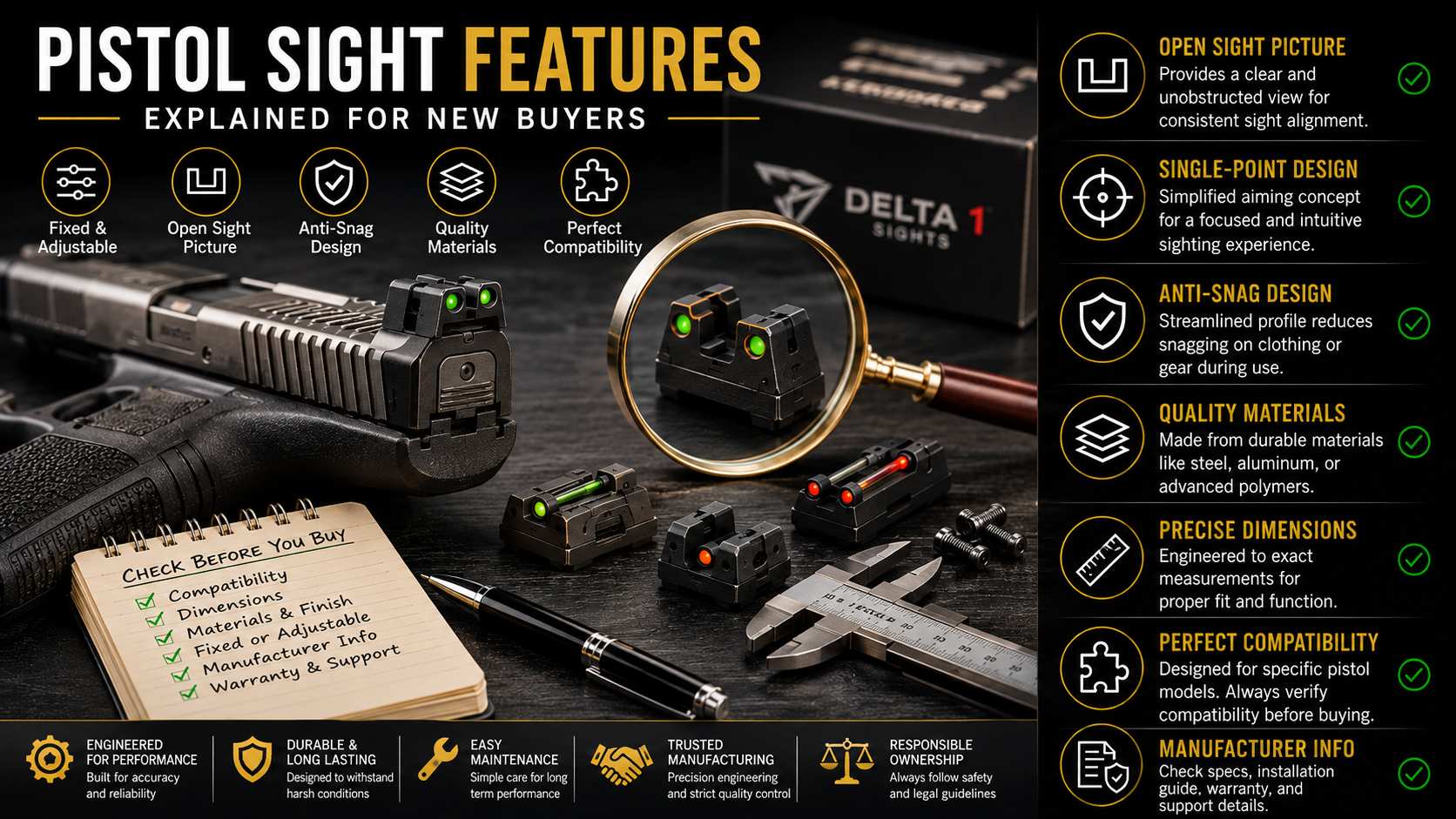
In addition to characteristics like an open sight picture and streamlined, anti-snag construction, modern sight makers like Delta 1 provide both fully adjustable and fixed designs. New purchasers can navigate the market more confidently if they are familiar with these phrases.
What Is a Pistol Sight?
A sighting element installed on a gun is called a pistol sight. Its design gives the gun’s sighting system a visual reference.
The design and construction of pistol sights can vary greatly. While some have adjusting methods, others are fixed. While some employ optical or lit technology, others employ conventional sight elements.
Due to the abundance of possibilities, consumers should first learn about the fundamental categories before examining specific products.
Fixed Pistol Sights
Fixed sights lack the adjusting mechanisms included in adjustable variants and have a predetermined setup.
They may be a desirable choice for purchasers who like a straightforward sight arrangement due to their uncomplicated style.
But “fixed” does not imply that all fixed sights are the same. Products can vary in terms of compatibility, profile, finish, size, and materials.
The precise firearm model should always be compared to the compatibility information provided by the manufacturer when buying a fixed sight.
Fully Adjustable Pistol Sights
Certain features of the sight configuration can be altered thanks to mechanisms included in fully adjustable sights.
This distinguishes them from fixed sights and may lead to a more intricate product design.
Before buying an adjustable sight, new customers should carefully go over the manufacturer’s documentation. Compatible platforms, dimensions, structure, and other pertinent features can all be explained in product specs.
Qualified professional assistance should be taken into consideration if installation or fitting calls for technical firearm knowledge.
Open Sight Picture
When looking at contemporary handgun sights, consumers may also come across an open sight picture.
In particular, Delta 1’s design concept places a strong emphasis on an open sight picture. In order to offer a unique sighting reference, the company bases its description of its sight system on a simplified visual concept.
It is helpful for prospective purchasers to realize that an open sight picture is a feature of the design rather than a promise of consistent outcomes for each individual.
Customers should concentrate on comprehending the manufacturer’s design rather than believing that one sight picture is always superior because individual preferences and situations can vary.
Single-Point Sight Design
A simplified single-point seeing idea is used by several contemporary sight systems.
One of the more distinguishing features of Delta 1’s sight design is the way it emphasizes this idea in its product descriptions.
Understanding how the function is described by the maker and how it fits into the overall sight design is crucial for purchasers.
Before making a purchase, it is important to verify the product’s compatibility and specs, just like with other firearm attachment.
Anti-Snag Design
Another feature that can be found in descriptions of contemporary handgun sights is an anti-snag profile.
A more streamlined physical appearance with fewer projecting features is generally referred to as an anti-snag design.
The sight design of Delta 1 places a strong emphasis on anti-snag construction.
This attribute should be taken into account by prospective customers together with other aspects of the product, like its size, structure, compatibility, and intended use.
An anti-snag profile is a feature of a product’s physical design and should not be taken as evidence that it is always appropriate for every firearm or circumstance.
Sight Materials
When building a handgun sight, materials play a crucial role.
Manufacturers may utilize steel, aluminum, polymers, optical materials, or mixtures of various materials, depending on the product.
Weight, durability, machinability, and environmental resistance are just a few of the attributes that distinguish different materials.
But substance is not the only factor that determines quality.
Additionally, a buyer should take into account engineering, measurements, manufacturing quality, finish, warranty support, and manufacturer paperwork.
Sight Finish
A sight’s finish can affect its appearance and possibly shield the underlying substance.
Depending on the product, different manufacturers may employ different finishing techniques.
Buyers should compare sights with detailed information on the finish and any environmental protection claims made by the manufacturer.
Even when a product has a protective surface, proper maintenance is still crucial.
Sight Dimensions
One of the most crucial details for prospective purchasers to verify are dimensions.
A sight’s breadth, height, length, or mounting arrangement may all have precise dimensions.
Compatibility with a specific gun may be impacted by these measurements.
Photographs should never be used by buyers to approximate measurements. Rather, they ought to utilize the written requirements provided by the manufacturer.
It is better to get in touch with the manufacturer or reseller before making a purchase if the dimensions or compatibility details are uncertain.
Compatibility
Prior to buying a pistol sight, compatibility should always be verified.
The size, mounting configurations, and sight configurations of various weapon models can vary.
Even if two products have similar appearances, they can not be compatible.
Before choosing a sight, new customers should determine the precise manufacturer and model of the handgun.
The compatibility listing for that particular product should then be compared with that information.
This little action can assist avoid making inappropriate purchases.
Why Manufacturer Information Matters
One of the best tools for assessing a sight is manufacturer documentation.
Materials, dimensions, compatible platforms, design features, warranty coverage, and maintenance needs can all be found on a comprehensive product page.
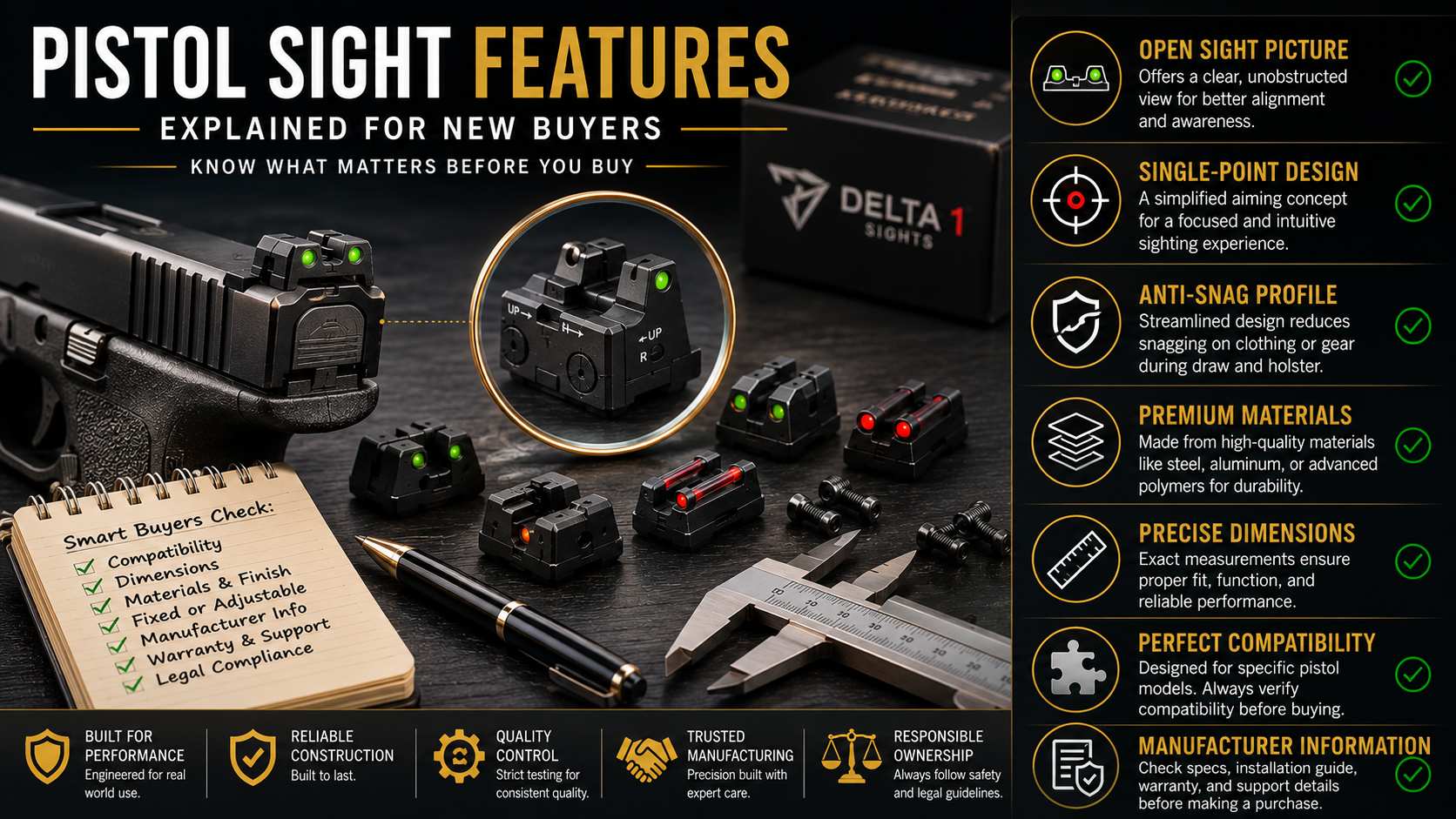
Instead of depending only on product photos or advertising claims, customers should carefully study this material.
Before placing a purchase, it is preferable to get clarification if a product listing leaves a crucial point unanswered.
Quality and Manufacturing
There are other factors that affect quality besides the materials used to create a sight.
The finished product may benefit from engineering, machining, dimensional consistency, finishing, and quality control procedures.
Delta 1 emphasizes the importance of engineering and machining in the development of its products.
This gives consumers another helpful consideration while doing product research.
Examine the entire product and the manufacturer’s information rather than concentrating on a specific feature.
Fixed vs. Adjustable: What Should New Buyers Consider?
The product and the legitimate needs of the customer determine whether to use fully adjustable or fixed sights.
Fixed sights have a clear layout and simple design.
Mechanisms that offer more configuration freedom are incorporated into fully adjustable sights.
It is not necessary to automatically regard either category as superior.
Compatibility, product specs, structure, intended use, and manufacturer instructions are important considerations for new purchasers.
Instead of just selecting the alternative with more features, the objective is to comprehend the distinctions.
What to Check Before Buying
New buyers can make the shopping process easier by checking a few important details before placing an order.
- Verify the precise model and manufacturer of the handgun.
- Verify the compatibility indicated for the sight.
- Examine the mounting details and proportions.
- Recognize whether the sight is fully adjustable or fixed.
- Examine the building supplies and finish.
- Examine the product documentation provided by the manufacturer.
- Verify customer service and warranty details.
- If technical fitting is necessary, think about hiring a professional.
- Before making a purchase, confirm the relevant rules and regulations.
Taking these steps can reduce confusion and help buyers make more informed decisions.
Choosing Quality Over Unnecessary Features
Many features can be found in modern pistol sights, however additional features do not always translate into a better product.
First, new purchasers should ascertain what they truly require.
For one consumer, a straightforward fixed sight would be suitable, while another might be expressly looking for an adjustable design.
Similarly, for some buyers, an anti-snag profile or an open sight picture could be crucial design elements.
Instead of making a purchase solely on the basis of marketing jargon, it is crucial to compare the product’s specified qualities with the intended application.
Responsible Ownership
Pistol sights should always be viewed in the context of proper gun ownership.
Regardless of the sight chosen, safe handling, proper instruction, understanding of maintenance, and adherence to relevant regulations are still crucial.
Responsible ownership behaviors cannot be replaced by an accessory.
New gun owners should think about getting the proper professional training and familiarizing themselves with local legislation.
Legal Considerations
Laws pertaining to firearms can differ significantly between nations, states, provinces, and local governments.
Firearm accessories, purchases, possession, storage, transit, and other activities may be subject to regulations.
Over time, these rules may also alter.
Customers should check current regulations through relevant official sources prior to making a purchase of a firearm-related accessory.
A product’s availability online does not guaranty that every consumer can legally buy or own it.
Final Thoughts
New clients may find the purchasing process much simpler if they are aware of basic handgun sight features. While modern features like open sight pictures, single-point sighting concepts, streamlined profiles, and diverse materials can further differentiate one product from another, fixed and fully adjustable designs enable several configurations.
Customers looking at Delta 1 goods should consider the company’s emphasis on engineered designs, completely adjustable and fixed options, open sight-picture principles, and anti-snag construction.
Buyers should, however, always consider more than just certain characteristics.
Before making a purchase, take into account compatibility, dimensions, construction, manufacturer paperwork, warranty support, maintenance requirements, and any applicable restrictions.
Finding the true need first and then comparing products based on trustworthy data is the best strategy.
Investing a little more time in learning about pistol sight features will help new purchasers make more responsible and educated purchases.
Frequently Asked Questions
What distinguishes adjustable pistol sights from fixed ones?
While fully adjustable sights contain mechanisms that enable specific features of their design to be altered, fixed sights have a predetermined configuration.
An open sight picture: what is it?
A sight design meant to offer a comparatively unhindered visual reference is called an open sight image. The manufacturer determines the precise design.
What is meant by “anti-snag”?
A streamlined physical profile with fewer projecting features is typically referred to as an anti-snag design. This feature is emphasized in the sight designs of Delta 1.
Why are the dimensions of the sight important?
Compatibility with a specific rifle may be impacted by dimensions. Instead of assuming measures from photos, buyers should always refer to the manufacturer’s specs.
What components go into making pistol sights?
Manufacturers may employ steel, aluminum, polymers, optical materials, or mixtures of materials, depending on the product.
Does better quality equate to a higher price?
Not always. Instead than focusing only on pricing, buyers should consider construction, compatibility, paperwork, warranty support, materials, and intended application.
Is it possible for all handguns to use the same sight?
No, the size and mounting configurations of various gun models can vary. Before making a purchase, compatibility should always be confirmed.
Is it necessary to hire an expert to install a handgun sight?
It is wise to speak with a qualified expert if installation or fitting calls for technical weapon knowledge. You should always adhere to the manufacturer’s directions.
