


Customers frequently consider design, look, or cost while selecting a handgun sight. But the components of pistol sights are just as significant. Durability, weight, corrosion resistance, finish quality, maintenance needs, and a sight’s general construction can all be impacted by the choice of materials.
Knowing these distinctions can greatly facilitate product research for consumers considering contemporary sight solutions. Material alone does not define a well-designed sight. The final product is influenced by manufacturing techniques, engineering, finishing, dimensions, compatibility, and quality control.
Delta 1 Sights designs both fully adjustable and fixed sights with a technical focus. Its product philosophy places a strong emphasis on anti-snag features, streamlined construction, a unique open sight picture, and a simplified sighting idea. Before making a purchase, consumers thinking about these kinds of products can benefit from knowing how the materials fit into the overall design.
Why Materials Matter in Pistol Sights
Despite being comparatively small parts, pistol sights must nonetheless be produced in accordance with precise design and dimensional specifications.
A manufacturer’s choice of material can affect attributes including surface finish, machinability, weight, corrosion resistance, and structural strength.
But content should never be considered in a vacuum.
Due to variations in engineering, manufacturing procedures, finishing, and quality control, two goods created from the same generic material may have rather different features.
For this reason, rather than selecting a sight just because it uses a specific material, purchasers should review the entire product specification.
Common Materials Used in Pistol Sights
A variety of materials can be used in the production of contemporary handgun sights.
Metal building is widespread, and different metals are used by manufacturers based on the demands of the particular design. Two examples that buyers can come upon are steel and aluminum.
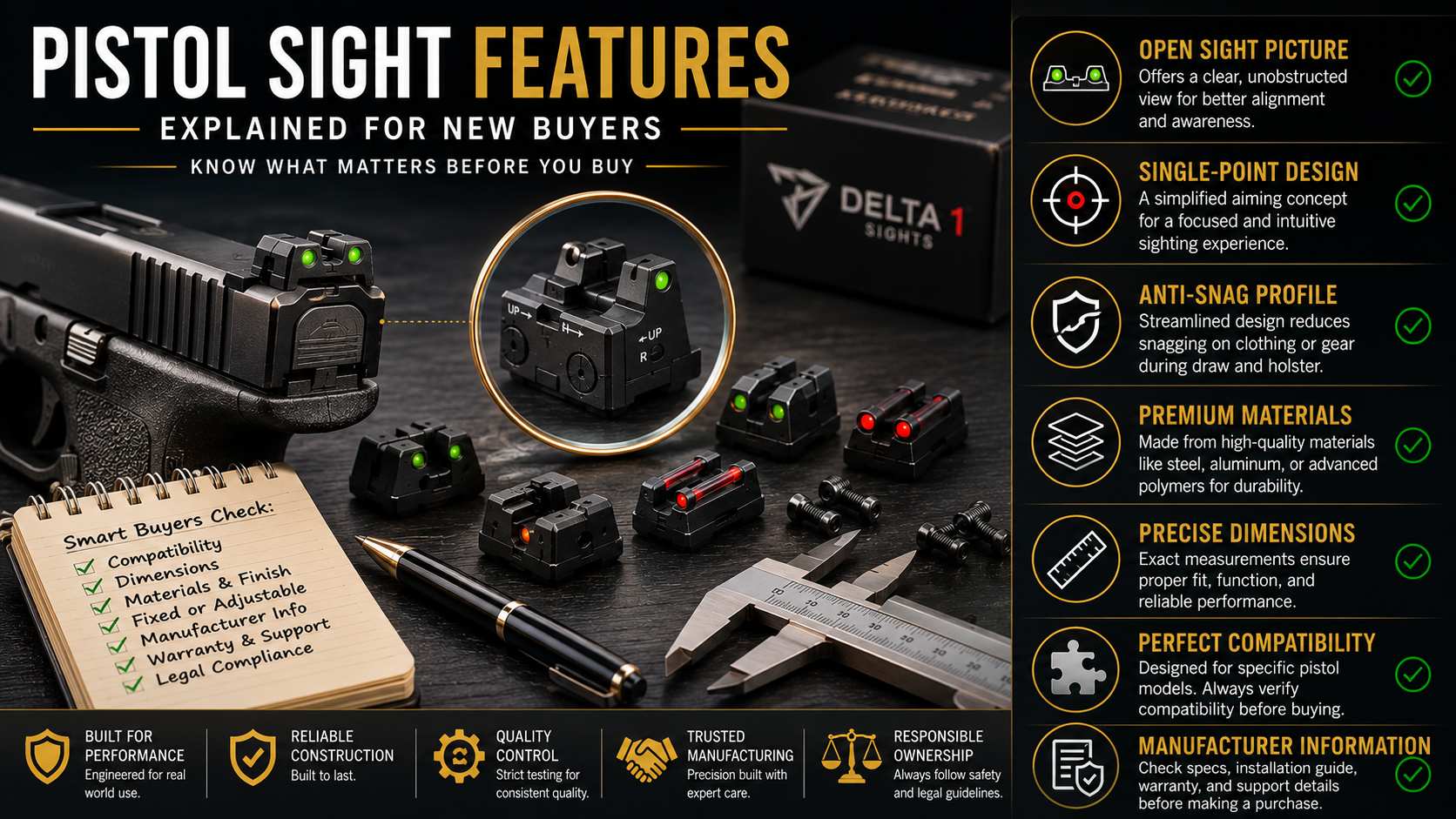
Additionally, certain items may include optical materials, electronic components, or polymer components.
The design and intended use of the sight determine the precise combination.
Customers should check for particular material details supplied by the manufacturer while conducting product research instead of depending solely on broad phrases like “premium” or “heavy duty.”
Steel Pistol Sights
Steel’s strength and durability make it a popular material for engineering items.
When available, consumers should pay attention to the manufacturer’s stated material specification because different varieties of steel can have varied qualities.
Additionally, steel construction can be paired with various coatings or surface treatments.
The product’s look and ability to withstand specific climatic conditions may be influenced by these finishing procedures.
Steel, however, does not always imply better quality. Precision in manufacturing, design, finishing, and upkeep are also important.
Aluminum Pistol Sights
Steel and aluminum offer distinct qualities.
It is helpful when producers wish to reduce product weight without sacrificing a solid designed structure because of its comparatively low density.
The precise specification is important since different aluminum alloys can have varying characteristics.
Consumers should consider all aspects of the product description, including construction, dimensions, finish, compatibility, and intended use, while assessing aluminum sights.
Just as a heavy sight is not inherently more durable, a lighter sight is not inherently superior.
Polymer Components
Certain sight designs and associated accessories may also contain polymer materials.
These materials can offer low weight and production flexibility, depending on the particular polymer.
However, consumers shouldn’t assume that all polymer products have the same qualities because the term “polymer” refers to a wide variety of materials.
The greatest source for learning about a product’s structure is its manufacturer’s specifications.
Optical Materials
Optical components are incorporated into certain contemporary handgun sights, especially fiber-optic designs.
Compared to conventional metal sight components, these materials have different properties.
Customers should examine the manufacturer’s information about the optical component, surrounding housing, environmental issues, and maintenance when assessing a sight with an optical element.
The entire product consists of more than just the optical component.
Material and Manufacturing Quality
Choosing the right materials is just one aspect of manufacturing excellence.
The final product may also be impacted by the material’s machining, shaping, finishing, inspection, and assembly.
This is especially true for compact designed components, where fit and dimensions may be crucial.
Delta 1’s approach to product creation places a strong emphasis on engineering and machining.
This serves as a helpful reminder to customers that a sight should be assessed using the entire manufacturing process rather than just the material name.
How Machining Can Influence Quality
Manufacturers can produce components in accordance with precise dimensional requirements thanks to machining.
A more predictable final product may result from consistent manufacturing.
Customers shouldn’t, however, assume that the term “machined” equates to high quality.
It is also important to take into account the manufacturer’s specifications, materials, product documentation, compatibility details, and warranty support.
Buyers have a better foundation for comparison when comprehensive technical information and reputable manufacturer assistance are combined.
Surface Finish and Protection
The features of a sight can also be influenced by the surface finish.
Depending on the material and product design, manufacturers might employ a variety of finishing techniques.
In addition to influencing appearance, a finish may shield the underlying material.
However, no finish should be taken for granted to render an object impervious to environmental exposure or corrosion.
Consumers should adhere to the maintenance and storage guidelines provided by the manufacturer.
Corrosion Resistance
Over time, metal goods may be impacted by environmental exposure.
Under the right circumstances, salts, moisture, humidity, and other chemicals can cause corrosion.
How a product reacts to these variables can be influenced by its material, finish, storage conditions, and maintenance procedures.
As a result, consumers should review the care and storage guidelines provided by the manufacturer.
The proper manufacturer or expert advice should be taken into consideration if obvious corrosion or damage appears.
Environmental Conditions
Depending on how they are used, transported, and stored, pistol sights may be subjected to various conditions.
Different materials can be affected differently by variations in temperature, humidity, moisture, dust, and other environmental factors.
Manufacturers may offer certain environmental restrictions or care advice.
Before making a purchase, customers should review this information and refrain from presuming that every sight is made for the same circumstances.
Durability Is More Than Material
It is common to associate certain materials with durability, but material alone does not determine how long a product will remain suitable.
Durability can depend on:
- Selection of materials
- Design and engineering
- Production quality
- Surface polish
- Exposure to the environment
- Upkeep of Storage
- The intended use
Because of this, consumers should be wary of claims that one material inherently ensures the highest level of durability.
A thorough assessment of the product paints a more accurate picture.
Fixed Sight Materials
Depending on the product, many materials can be used in the production of fixed pistol sights.
Buyers should carefully consider construction, size, compatibility, finish, and manufacturer standards because fixed sights have a predetermined configuration.
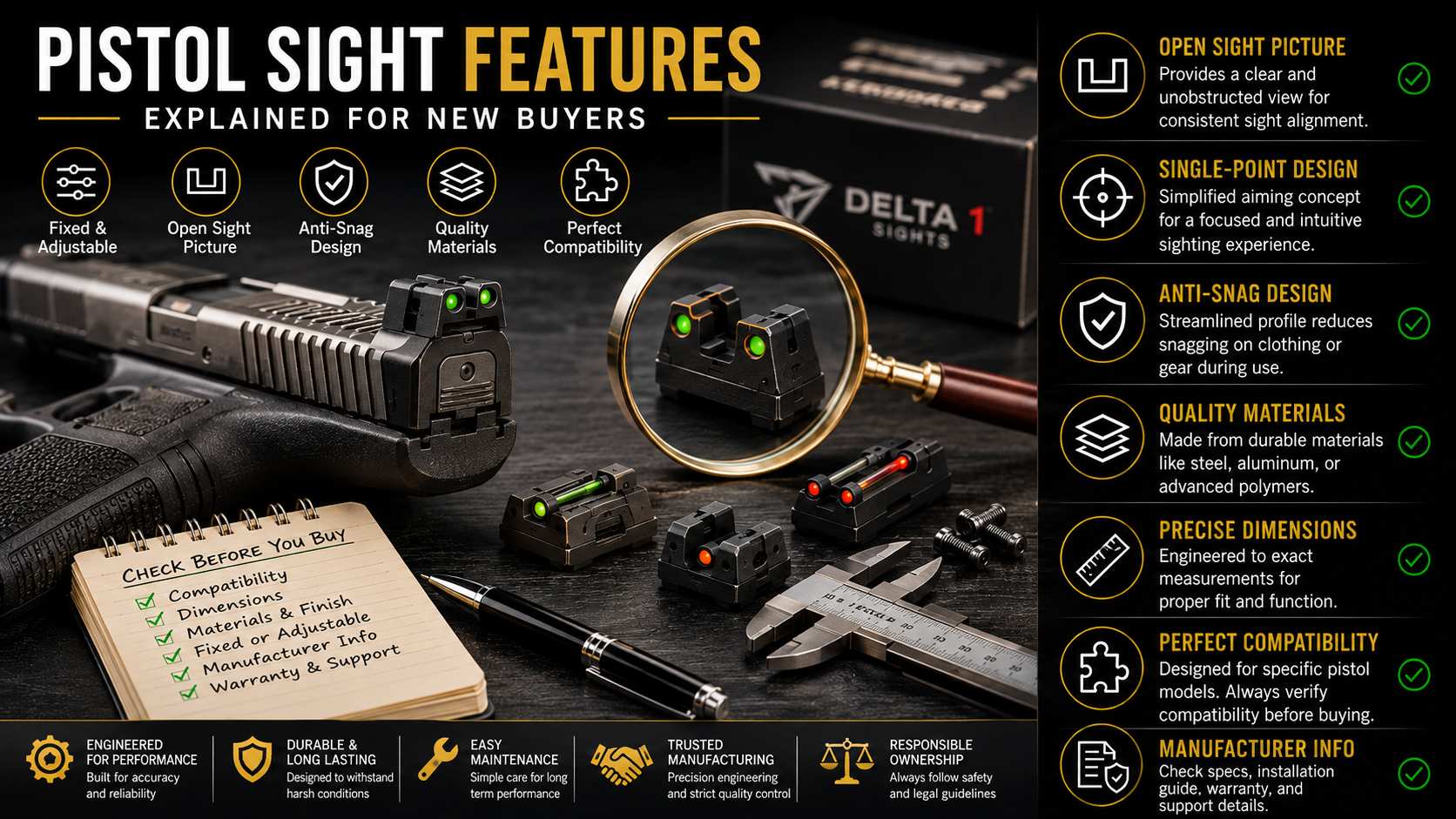
Based on its unique design philosophy, Delta 1 provides fixed sight devices.
Instead of presuming that every fixed sight has the same construction or material composition, customers should investigate the particular model they are thinking about.
Fully Adjustable Sight Materials
Compared to fixed designs, fully adjustable sights may have more mechanical parts.
This implies that material selection is not limited to the primary sight body but can also apply to other components of the device.
For information on construction, compatibility, dimensions, adjustment mechanisms, and maintenance, customers should consult the manufacturer’s product information.
Expert professional assistance should be taken into consideration if technical installation or fitting is necessary.
Weight and Material Selection
The choice of materials can also affect a sight’s weight.
Manufacturers can choose different materials to produce varied weight characteristics since different materials have different densities.
Customers should refrain from using weight as a direct indicator of quality, though.
A heavier product isn’t always more durable, and a lighter product isn’t always better.
Instead, weight should be taken into account in conjunction with the product’s design, size, compatibility, and intended use.
Materials and Product Appearance
The choice of material and polishing can also affect how a handgun sight looks.
Surface textures and looks might vary depending on the finish.
This could be important for consumers who are concerned about how an accessory looks with their gun.
However, interoperability and published product specifications should take precedence over looks.
Purchasing an eye-catching sight that is incompatible with the intended firearm is inappropriate.
How to Evaluate Material Claims
Terms like “premium metal,” “precision machined,” or “high durability” can be used in online product descriptions.
Although purchasers should seek out particular supporting material, these descriptions might offer helpful marketing context.
Details about materials, size, compatible platforms, construction, warranty coverage, and intended application are typically included in the best product listings.
When accessible, customers should also examine the manufacturer’s documentation.
This makes it simpler to discern between helpful technical information and generic promotional jargon.
Compatibility Still Comes First
A sight cannot be made compatible with an inappropriate firearm, not even with the best material.
Different mounting configurations and dimensions can be used with different pistol platforms.
Before choosing a sight, buyers should determine the precise model of rifle and then check it against the compatibility data provided by the manufacturer.
It is not appropriate to provide photos as evidence of compatibility.
It is safer for customers to get in touch with the manufacturer, retailer, or a certified expert before making a purchase if they are unsure about a product’s fit or setup.
What Buyers Should Check Before Purchasing
A few simple checks can make the buying process much more effective.
- Verify the precise model and manufacturer of the handgun.
- Examine the compatibility specified for the sight.
- Verify the construction materials listed.
- Analyze mounting details and measurements.
- Find out if the design is completely changeable or fixed.
- Examine the environmental care and finish information.
- Examine the warranty information and manufacturer’s documentation.
- When technical fitting is necessary, think about hiring an expert.
- Before making a purchase, confirm the relevant rules and regulations.
This checklist is intended for responsible product research and does not replace professional or legal advice.
Delta 1 and Modern Sight Design
Engineering, machining, and a unique approach to sight design are all part of Delta 1’s product philosophy.
The company highlights features including an open sight picture, a streamlined single-point sighting philosophy, and an anti-snag profile and provides both fixed and fully adjustable choices.
This more comprehensive engineering approach includes material selection.
What matters to consumers is not just the type of material utilized, but also how that material fits into the overall design of the product.
Before making a purchase, customers should check the precise Delta 1 product listing for the most recent details.
Maintenance and Long-Term Care
Any accessory’s long-term condition can be improved with proper maintenance.
Consumers should adhere to the manufacturer’s particular inspection, cleaning, storing, and care instructions.
Considerations may vary depending on the type of material.
While optical or electrical components may need extra care, metal products may need to be protected from moisture and rust.
A professional inspection might be necessary if a sight looks damaged, cracked, corroded, loose, or otherwise suspicious.
Avoiding unsupported fixes or alterations is advised.
Manufacturer Documentation
When assessing the quality of a product, manufacturer documentation is especially helpful.
Materials, size, compatibility, maintenance, warranty coverage, installation specifications, and product limits can all be found in documentation.
Before utilizing an item, customers should go over this information and save it for later.
Buyers should ask questions instead than making assumptions when a shop listing and manufacturer documentation seem discordant.
Quality vs. Price
When shopping online, price is a crucial factor to take into account, but it shouldn’t be the only measure of quality.
A more costly sight isn’t always better.
Similarly, a less expensive product is not inherently inappropriate.
Materials, construction, manufacturing details, compatibility, warranty support, and intended use should all be compared by buyers.
This produces a more well-rounded foundation for choosing what to buy.
Responsible Ownership
Pistol sights are just one aspect of proper gun ownership.
Additionally, owners should be aware of safe handling procedures, maintenance, responsible transportation, suitable education, and relevant laws.
These obligations cannot be replaced by accessories.
Professional training may be beneficial for new gun owners, and they should familiarize themselves with local regulations.
Legal Considerations
Laws pertaining to firearms differ between states and are subject to change.
Firearms, accessories, purchases, possession, transit, and storage may all be subject to regulations.
Before acquiring or owning firearm-related products, consumers should confirm current regulations with the relevant official sources.
A product’s availability through an online retailer does not guaranty that it is legal for every consumer or jurisdiction.
Customers should speak with a certified legal professional or the appropriate authority where legal requirements are unclear.
Final Thoughts
Customers can make better purchasing selections if they are aware of how handgun sight materials impact durability and performance. Different qualities can be provided by steel, aluminum, polymers, optical materials, and other components, but the quality of a product is not always determined by a single substance.
A sight’s overall qualities are influenced by a number of factors, including engineering, surface finishing, size, compatibility, maintenance, and environmental factors.
In addition to material standards, buyers looking into Delta 1 can benefit from the company’s emphasis on engineering fixed and completely adjustable sight designs, open sight-picture concepts, streamlined construction, and anti-snag qualities.
Evaluating the entire product instead of concentrating on a single element is the most crucial phase.
Before making a purchase, consumers should check for compatibility, go over the precise material and construction details, go over manufacturer paperwork, comprehend maintenance and warranty requirements, and validate any applicable laws.
Customers can compare items based on trustworthy information rather than just marketing jargon when they go through a deliberate purchasing procedure. Customers can approach pistol sight shopping with more awareness and select choices that are suitable for their own situation by comprehending the relationship between materials, manufacturing, and durability.
Frequently Asked Questions
Why are materials important for pistol sights?
Features including weight, structure, corrosion resistance, machinability, and long-term care can all be influenced by the materials used. However, engineering and manufacturing also have an impact on the overall quality of the product.
Which materials are frequently utilized?
Manufacturers may utilize steel, aluminum, polymers, optical materials, or mixtures of various materials, depending on the product.
Is steel always more resilient than aluminum?
Not by default. distinct materials have distinct qualities, and design, production, finishing, exposure to the environment, and upkeep all affect overall durability.
Is it better if it’s lightweight?
No, weight is just one feature. Compatibility, structure, dimensions, intended usage, and manufacturer specifications should all be taken into account by buyers.
Does durability depend on the finish?
Depending on the material and finishing technique, a surface finish can influence corrosion resistance and offer protection. Consumers should adhere to the care instructions provided by the manufacturer.
To what extent does machining quality matter?
Dimensional uniformity and overall construction can be impacted by machining and manufacturing techniques. Along with other product features, buyers should take machining information into account.
Can I judge a sight’s quality only by looking at its material?
No, the evaluation consists of more than just the material. Additionally important are engineering, production, finishing, compatibility, paperwork, and warranty support.
How can I determine which sight is appropriate for my handgun?
Determine the precise model of firearm and compare it with the manufacturer’s compatibility data for the particular sight. Before making a purchase, get clarification if you’re unsure.
Do I need a sight installed by a professional?
It is wise to speak with a certified specialist if installation or fitting requires technical weapon knowledge. You should always adhere to the manufacturer’s directions.
Are pistol sights permitted everyplace?
Jurisdiction-specific regulations are subject to change. Before acquiring or owning accessories related to firearms, consumers should confirm current regulations.
