


Purchasing a handgun sight is a significant choice, especially in light of the wide variety of styles, materials, combinations, and manufacturers that are offered online. Even though a sight may appear impressive in pictures, it doesn’t always indicate if it is well-made, compatible with your gun, or suitable for its intended use.
Before making a purchase, consumers should look past marketing jargon and consider the specifics that reveal a product’s manufacturing and design. You can get a better idea of what you are thinking about by looking at construction materials, machining quality, finish, dimensions, compatibility, design features, manufacturer documentation, warranty support, and product reputation.
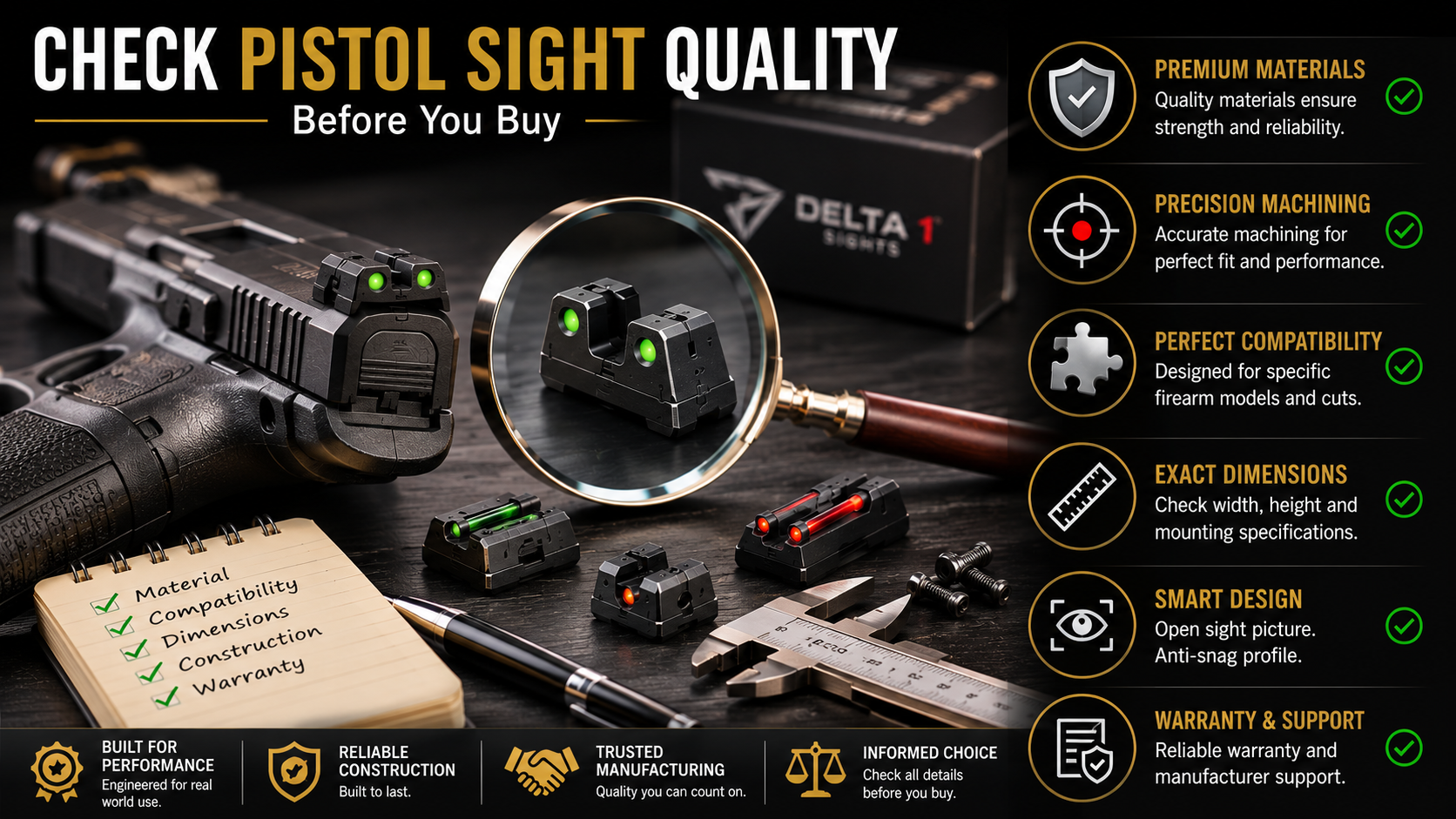
This kind of assessment is particularly helpful for clients looking into contemporary sight solutions like those provided by Delta 1. With fixed and completely adjustable choices, an open sight-picture idea, a single-point sighting design, and an anti-snag profile, Delta 1 showcases its products with an engineering-focused design philosophy.
Every sight should still be assessed in accordance with its unique requirements, though.
This tutorial discusses how to evaluate the quality of a pistol sight before making a purchase, what information to look for on a product page, how production and materials affect quality, why compatibility is important, and what inquiries responsible purchasers should make before making a purchase.
Why Pistol Sight Quality Matters
Despite being a relatively small part, a pistol sight is nevertheless an engineered product that must adhere to strict construction and dimensional specifications.
Therefore, quality goes beyond appearance.
A well-designed sight should be compatible with the specified rifle platform, have proper construction, appropriate manufacturing quality, and well-documented specs.
Additionally, consumers should be able to locate trustworthy information regarding the product’s limitations, warranty, maintenance, and intended use.
For this reason, research should be done before making a purchase rather than depending just on pricing or pictures.
Start With the Product Specifications
Carefully reading the product specifications is the first step in assessing a handgun sight.
Enough details should be included in a professional product listing so that buyers can comprehend what they are looking at.
Construction materials, dimensions, compatibility information, sight configuration, finish, adjustment characteristics, and warranty details are examples of parameters that may vary depending on the product.
Customers shouldn’t just speculate if crucial information is missing.
Alternatively, people can get clarity before making a purchase by getting in touch with the manufacturer or store.
For accessories connected to firearms, it is especially crucial to have clear specifications because compatibility may depend on quite specific requirements.
Check the Exact Firearm Compatibility
If a high-quality sight is incompatible with the intended firearm, it is useless.
One of the most crucial things consumers should do before making a purchase is this.
Sight size, attachment configurations, and mounting methods might vary throughout pistol models. Products may not be interchangeable even if they have almost the same appearance.
After determining the precise manufacturer and model of the handgun, customers should compare that information with the compatibility requirements provided by the sight manufacturer.
Don’t depend just on a picture or a generic product name.
You should verify the precise product listing.
Understand the Sight Configuration
Additionally, buyers need to know if the product is totally adjustable or fixed.
The adjustment mechanisms present in an adjustable design are absent from a fixed sight, which has a predetermined configuration.
A completely adjustable sight has devices that enable the modification of certain configuration elements.
Since these are distinct design philosophies, neither should be deemed superior by default.
The firearm platform, product specs, intended legal use, and unique situation all influence the best choice.
Customers can more accurately compare products when they are aware of the setup.
Examine the Construction Materials
When assessing the quality of a handgun sight, materials might offer helpful information.
Steel, aluminum, plastics, optical components, or mixtures of these materials can be used in modern sight devices.
Instead than depending on broad terms like “premium construction,” customers should search for precise material details.
For instance, a listing that merely states that a product is durable does not provide shoppers with as much helpful information as one that specifically identifies the material utilized in a product.
Along with manufacturing quality, finishing, design, and warranty support, material should still be taken into account.
Why Steel May Be Used
Steel’s strength, durability, and machining qualities make it a popular material for engineered items.
When a material specification is given, purchasers should pay attention to it because different types of steel can have varied qualities.
Additionally, a steel sight’s properties can vary based on the surface finish and manufacturing method.
Because of this, the term “steel sight” is insufficient to assess the quality of a product.
Customers ought to take the entire construction into account.
Aluminum Construction
Steel and aluminum have different sets of properties, especially when it comes to weight and density.
When a lightweight design is desired, some producers might employ aluminum.
But being lightweight does not always equate to being better.
Consumers should assess the material according to its intended use, product specifications, and the manufacturer’s declared design objectives.
Instead of believing that one material is always superior to another, it is crucial to comprehend the rationale behind the use of a particular material.
Polymer Components
Modern sight designs may also use polymer materials.
Polymers can provide features like low weight and production flexibility, depending on the particular material and application.
But the word “polymer” refers to a wide range of substances.
Therefore, instead of drawing conclusions just from the material category, customers should examine the manufacturer’s product details.
Look at the Machining and Manufacturing Information
When assessing a sight, manufacturing quality is yet another crucial consideration.
A manufacturer may employ machining techniques intended to create components with exact dimensions and uniformity.
As part of its approach to product creation, Delta 1 places particular emphasis on engineering and machining.
This is helpful information for consumers, but it should still be considered in conjunction with the real product specs.
Seek out precise details regarding the materials, dimensions, design, manufacturing, warranty, and platforms that are compatible.
Compared to a single marketing statement, the combination of these details provides a far better indicator of product quality.
Examine the Surface Finish
Both appearance and some defensive qualities can be affected by surface treatment.
Depending on the material and intended usage, manufacturers may employ a variety of finishes.
Customers should seek for details on the finish and any related manufacturer claims when evaluating a product.
A protective finish, however, should not be taken to mean that a product is impervious to environmental harm or corrosion.
Storage and proper maintenance are still crucial.
Check for Consistent Design Details
When utilized properly, product photos can still offer valuable information.
Customers can examine apparent building details rather than relying solely on appearance to determine quality.
Consistent surfaces, well-defined elements, clean edges, and an overall cohesive design can all offer helpful visual context.
Photographs, however, are unable to verify compatibility, interior construction, measurements, or material specifications.
Visual assessment should therefore complement technical documentation rather than take its place.
Understand the Sight Profile
A sight’s physical profile might be a crucial factor in design.
A key component of Delta 1’s product concept is a streamlined, anti-snag design.
In general, a design with fewer protruding features is referred to as an anti-snag profile.
In order to comprehend the design, customers who are interested in this feature should examine the specific product’s measurements and images.
Compatibility and intended use should be assessed concurrently with the sight profile.
Product quality cannot be determined solely by its sleek appearance.
Consider the Sight Picture Design
Different sight-picture concepts can be used with modern handgun sights.
Delta 1 uses a streamlined single-point sighting model and an open sight picture to describe its goods.
It is crucial for consumers to comprehend this aspect of the product.
Customers shouldn’t assume that one style is suitable for everyone, though, as sight-picture preferences can differ from person to person.
While the details of each product should be reviewed before to purchasing, the manufacturer’s description should be used to comprehend the intended notion.
Fixed Sight Quality Considerations
Customers should consider construction, compatibility, size, finish, design, and manufacturer support when assessing a fixed sight.
Customers may give special attention to whether the product is made especially for the specified firearm platform because fixed sights have a predetermined configuration.
All fixed sights are not created equal merely because they lack adjusting mechanisms.
Materials, profiles, mounting arrangements, and manufacturing techniques can vary among manufacturers.
As a result, each product needs to be assessed separately.
Fully Adjustable Sight Quality Considerations
Because their design includes adjustment mechanisms, fully adjustable sights need extra care.
Consumers should read the manufacturer’s information about dimensions, compatibility, maintenance, guarantee, construction, and components linked to adjustments.
A deeper comprehension of the product may be necessary for a more mechanically intricate design.
Customers should think about hiring a competent professional to help with technical fitting or installation.
Additional adjustability features are not always a sign of better quality.
Review Manufacturer Documentation
Manufacturer documentation can be one of the strongest indicators of a professionally supported product.
Useful documentation may include:
- Product dimensions and specs
- Platforms for compatible firearms
- Construction details and materials
- Installation or fitting specifications
- Instructions for upkeep and care
- Terms of warranty and product restrictions
- Contact details and support details for the manufacturer
Before making a purchase, customers should study this information.
Customers have a better foundation for assessing a product when a manufacturer offers thorough documentation.
Check Warranty Support
Further details regarding manufacturer support may be found in warranty coverage.
It is important for customers to know what is covered by the warranty, how long it is valid, and whether there are any restrictions or conditions.
Although a clear warranty cannot ensure that a product will never have a problem, it can offer helpful assistance in the event that a manufacturing issue arises.
After making a purchase, buyers should keep their product paperwork and receipts.
Don’t Judge Quality by Price Alone
While price is a significant consideration when shopping, it shouldn’t be the sole indicator of quality.
A costly sight is not always better.
Similarly, a cheaper sight is not necessarily of worse quality.
Customers should instead evaluate manufacturer support, warranty, construction, compatibility, materials, specs, and intended use.
This method offers a far more impartial assessment.
Be Careful With Marketing Language
Although marketing language can make things seem remarkable, consumers should discern between recorded specifications and promotional promises.
Terms like “premium,” “ultimate,” “unmatched,” and “extreme durability” do not replace technical details.
Consumers should search for proof to back up product claims.
When comparing items, it is more helpful to have clear materials information, dimensions, compatibility specifications, warranty information, and manufacturer paperwork.
Read Customer Reviews Carefully
Although they can offer helpful information, customer reviews shouldn’t be regarded as conclusive proof of a product’s quality.
A reviewer can have different expectations, a different model of firearm, or a different configuration.
Manufacturer specifications should continue to be the major source of technical information, while reviews can assist in identifying recurrent queries or issues.
If several clients report the same problem, it could be worthwhile to look into it more.
But a purchase decision shouldn’t be made only based on one review.
Check the Retailer’s Product Information
Customers should study the entire product page before making a purchase from an online shop.
Rather of being in the primary product title, important information may occasionally appear down on the site.
Examine product descriptions, warranty details, compatibility information, specifications, and customer support details.
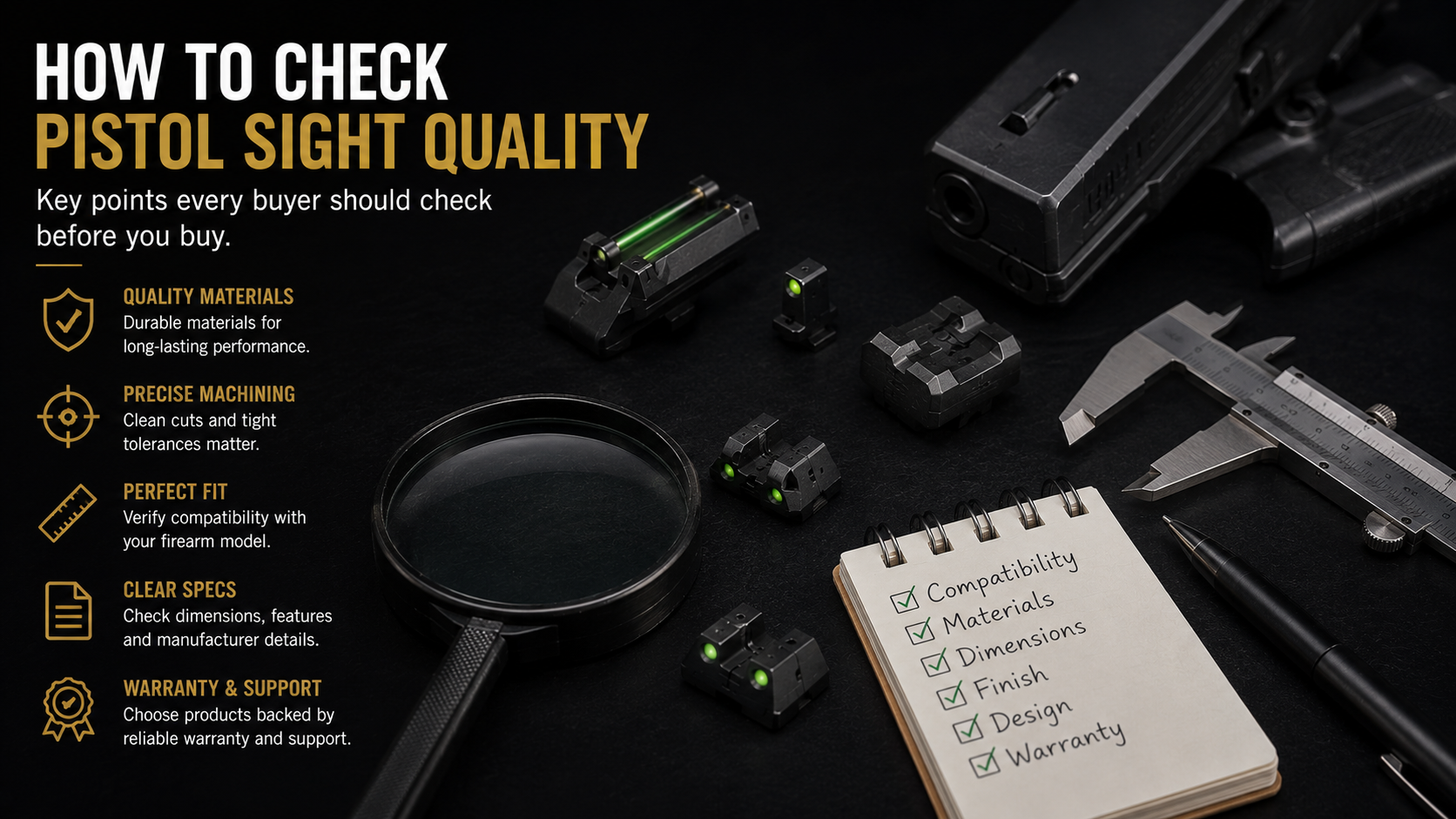
Before making a purchase, get in touch with the shop if a crucial detail is lacking.
Before placing an order, a little explanation can help avoid a much bigger issue down the road.
Compatibility Should Always Be Verified
Even a high-quality product can be unsuitable if it does not match the intended firearm.
This is why compatibility deserves its own verification step.
Customers should identify:
- the specific maker of firearms.
- The precise model of firearm.
- the appropriate setup of the sight.
- Compatible platforms for the product are listed.
- any specifications unique to a particular model.
If the information does not clearly match, customers should seek clarification before purchasing.
Professional Installation and Fitting
Technical installation or fitting may be necessary for certain handgun sights.
Consumers who don’t know enough about firearms might think about speaking with an expert.
This is especially crucial when the product calls for special mounting configurations or specialized fittings.
You should always adhere to the manufacturer’s directions.
Consumers should refrain from trying unfamiliar weapon work or making unsupported modifications based just on generic internet information.
Maintenance and Durability
Appropriate care is still necessary for a high-quality output.
Consumers should adhere to the cleaning, inspection, storage, and maintenance guidelines provided by the manufacturer.
Over time, materials and finishes may be impacted by environmental exposure.
Depending on the product, deterioration may be caused by moisture, humidity, dust, chemicals, and other factors.
A professional checkup could be necessary if a sight becomes broken, corroded, cracked, loose, or in any other way dubious.
A Simple Pre-Purchase Quality Checklist
Before purchasing a pistol sight, buyers can use the following checklist:
- Verify the product’s compatibility and the precise model of firearm.
- Examine the building materials used at the site.
- Examine the mounting details and proportions.
- Check to see if the sight is fully adjustable or fixed.
- Analyze the product specifications and design provided by the manufacturer.
- Examine the facts about environmental care and surface finish.
- Examine the warranty and customer service information.
- Examine product restrictions and manufacturer documentation.
- If technical fitting is necessary, think about hiring a professional.
- Check the laws and rules that are currently in effect for the product.
This checklist is intended to support informed shopping and does not replace professional or legal advice.
How Delta 1 Approaches Sight Design
An example of a manufacturer using a unique approach to contemporary pistol sight design is Delta 1.
The firm emphasizes an open sight image, simplified sighting idea, streamlined construction, and anti-snag features while providing both fixed and completely adjustable configurations.
Additionally, engineering and machining are highlighted on the website as crucial components of the development process.
These features offer users helpful places to look into.
Customers can inspect each Delta 1 product, go over its specifications, confirm compatibility, and think about if the design meets their needs instead of depending on broad claims.
Why Individual Product Pages Matter
A manufacturer’s general website description provides useful background, but the individual product page is often more important for purchasing decisions.
Different products can have different:
- Dimensions
- Platform compatibility
- Materials
- Configurations
- Features of adjustment
- Details about the warranty
- Installation specifications
Customers should therefore avoid assuming that every product within a brand’s range has identical characteristics.
The exact model should always be evaluated.
Quality and Responsible Ownership
Although product quality is crucial, responsible gun ownership involves more than just this.
secure handling, responsible transportation, proper education, maintenance knowledge, secure storage, and adherence to relevant regulations are still crucial.
These obligations cannot be replaced by any accessory.
Additionally, clients should know when to seek professional help.
Legal Considerations Before Purchase
Laws pertaining to firearms might differ greatly between states.
Ownership of firearms, attachments, purchases, transit, storage, and other actions may all be subject to requirements.
Over time, these regulations may alter.
Therefore, before buying or possessing firearm-related products, consumers should confirm current regulations through the relevant official authorities.
A product’s presence online does not guaranty that it is lawful for every consumer or place.
A knowledgeable legal professional or the appropriate authority should be consulted by anyone unsure about applicable requirements.
Final Thoughts
The key to determining the quality of a handgun sight before making a purchase is to look past appearances and advertising.
Construction materials, manufacturing quality, dimensions, finish, sight configuration, compatibility, manufacturer documentation, warranty support, and product-specific requirements should all be considered by a conscientious buyer.
Customers looking to compare Delta 1 can benefit from the company’s emphasis on engineering sight designs, completely adjustable and fixed alternatives, open sight-picture concepts, streamlined construction, and anti-snag features.
But quality is not determined by a single trait.
Examining the entire product and verifying that its listed specs align with the intended firearm platform and valid use is the best way to make a purchase.
Verify compatibility, carefully read the manufacturer’s instructions, comprehend warranty and maintenance requirements, and research local regulations before placing an order.
Above all, keep in mind that safe gun ownership involves more than just a high-quality accessory. Priorities should continue to include safe storage, proper instruction, safe handling, maintenance knowledge, responsible transportation, and legal compliance.
Customers can make better decisions and select products based on trustworthy facts rather than conjecture by spending a few additional minutes researching a pistol sight before making a purchase.
Frequently Asked Questions
How can I determine the quality of a handgun sight?
Consider the entire product instead of just a single feature. Materials, construction, machining, measurements, compatibility, finish, manufacturer documentation, warranty support, and customer service should all be taken into account.
Does a better pistol sight come at a higher cost?
Not always. Construction, specs, compatibility, warranty, manufacturer support, and intended use should all be taken into account in addition to price.
Which materials are frequently found in handgun sights?
Manufacturers may employ steel, aluminum, polymers, optical materials, or mixtures of materials, depending on the product.
What makes compatibility crucial?
If a sight does not fit the dimensions or mounting configuration of the firearm, it may be well-made but still inappropriate.
Can I use pictures to assess visual quality?
Although photos can offer helpful visual information, they are unable to verify interior construction, compatibility, material composition, or technical parameters.
What should a product description include?
Examine the precise dimensions, materials, sight configuration, intended usage, warranty details, and manufacturer documentation of compatible firearm platforms.
Are adjustable sights of higher quality than fixed sights?
No, fully adjustable and fixed sights use distinct design strategies. Neither category is inherently better than the other.
What constitutes an anti-snag sight design?
A streamlined profile with fewer projecting features is typically used in anti-snag designs. The manufacturer’s design determines the precise features.
Do I need to install a handgun sight myself?
A qualified specialist should be consulted if installation or fitting requires technical weapon knowledge. You should always adhere to the manufacturer’s directions.
What is the significance of manufacturing documentation?
quite significant. Compatibility, size, maintenance, warranty, installation, and product limitations can all be found in documentation.
Can a sight’s great quality be demonstrated by user reviews?
No, reviews can offer helpful context, but they should be taken into account in addition to manufacturer standards and expert advice.
Are there any legal restrictions on pistol sights?
Jurisdiction-specific requirements are subject to change. Before acquiring or owning accessories related to firearms, consumers should confirm the regulations in effect.
