


Customers frequently consider design, look, or cost while selecting a handgun sight. Pistol sights’ construction, durability, weight, corrosion resistance, finish, and maintenance needs can all be significantly impacted by the materials used. When comparing various sight options, customers can make better decisions if they are aware of these factors.
There are many different styles and materials available for contemporary pistol sights. While some employ conventional metal structure, others might use aluminum, plastics, optical components, or mixtures of various materials. The unique product, its intended use, compatibility, and the manufacturer’s requirements all influence the best option.
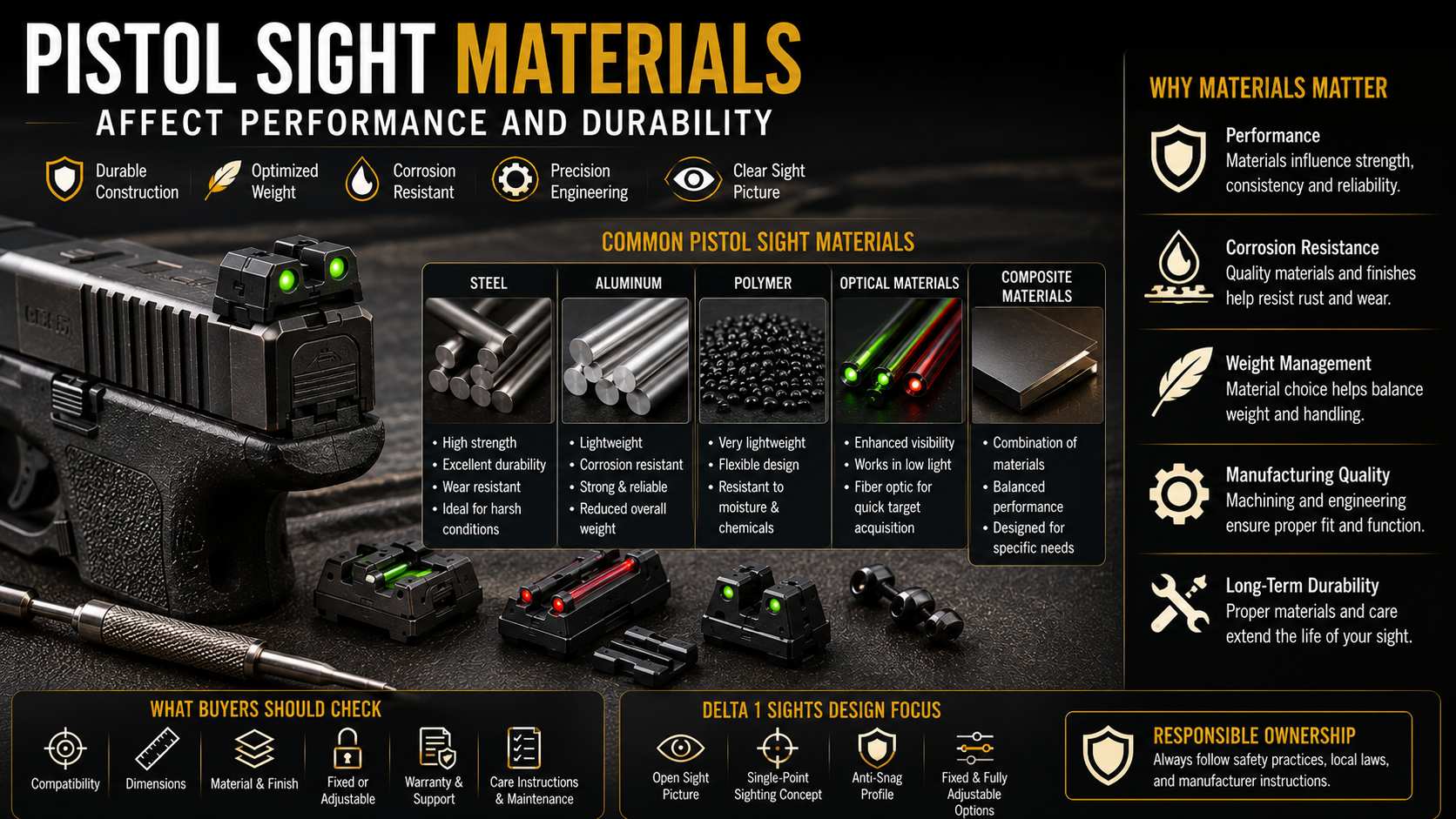
Because the company specializes in specialized fixed and completely adjustable sight designs, material selection is very intriguing to clients looking at Delta 1 products. Additionally, Delta 1 emphasizes features including an anti-snag profile, streamlined construction, an open sight picture, and a simpler sighting philosophy.
But substance is not the only factor that determines quality. The final result is influenced by engineering, machining, finishing, dimensions, compatibility, and appropriate maintenance.
Why Materials Matter in Pistol Sight Design
Despite being a relatively small part, a pistol sight is nevertheless an engineered product that must adhere to strict construction and dimensional specifications.
A manufacturer’s choice of material can affect a number of the final product’s features. These could include surface polish, machining needs, weight, resistance to environmental exposure, and structural qualities.
The benefits of different materials can vary. For instance, steel is renowned for its durability and strength, whereas aluminum is typically thought of as being lighter. Certain sight designs may use optical materials, and polymer components can offer more manufacturing flexibility.
Because of this, consumers ought to look past terms like “metal” or “premium material.”
Much more helpful information can be found in the full product specification.
Common Materials Used in Pistol Sights
A variety of materials can be used in the production of contemporary handgun sights.
Many sight designs include metal, and manufacturers choose various materials based on the needs of the device.
Two examples that buyers can come upon are steel and aluminum. Additionally, certain items may include optical or polymer components.
The manufacturer’s engineering method, intended application, manufacturing process, and desired product attributes all influence the decision.
Instead of depending solely on promotional descriptions, consumers should look for precise material details provided by the manufacturer while conducting internet research.
Steel Pistol Sights
Steel’s strength and durability make it a common material in many engineered items.
Buyers should check the precise material specification provided by the manufacturer because different types of steel may have different qualities.
The final features of a steel sight can also be influenced by the production process. The final product is a result of quality control, precision machining, and finishing.
Therefore, just because a steel sight is made of steel does not mean that it is of superior quality.
Material is only one aspect of a much more comprehensive assessment.
Aluminum Pistol Sights
Aluminum provides a distinct set of qualities.
Its comparatively low density in comparison to many steel products is one of its noteworthy characteristics. Because of this, manufacturers creating lightweight components may find aluminum advantageous.
Additionally, different aluminum alloys may have distinct characteristics.
Therefore, rather than assuming that every aluminum sight has the same features, customers should review the manufacturer’s specs.
Careful consideration should also be given to weight. A heavier sight is not inherently more durable, nor is a lighter sight necessarily better.
Weight alone is not as important as the overall design.
Polymer Components
Additionally, some sight designs and contemporary rifle attachments might use polymer materials.
These materials can provide low weight and production flexibility, depending on the specific polymer.
However, the term “polymer” refers to a wide range of materials with various characteristics.
As a result, buyers ought to examine the manufacturer’s unique product details.
A broad category of materials is insufficient to assess the compatibility or quality of a certain sight.
Optical Materials
Optical components are included into some contemporary sight designs.
One example is fiber-optic components. Unlike traditional metal sight elements, these components are made to interact with ambient light.
The manufacturer’s information about construction, maintenance, environmental restrictions, and intended usage should be reviewed by consumers looking into items using optical components.
Additionally, rather than being viewed as a stand-alone feature, the optical component should be viewed as a component of the entire sight.
How Manufacturing Affects Durability
While choosing the right materials is crucial, production quality is just as vital.
The final product can be affected by how a material is formed, machined, finished, examined, and assembled.
Manufacturers can build components in accordance with precise dimensional standards with the use of precision manufacturing.
Delta 1’s approach to sight development places a strong emphasis on engineering and machining.
This is a crucial distinction for consumers. Both the materials utilized and the accessible production data should be taken into consideration when evaluating a product.
Buyers have a better basis for comparison thanks to factory documentation and clear specifications.
Surface Finish and Corrosion Resistance
A sight’s finish can affect how it looks and possibly give the underlying material more protection.
Depending on the product, different manufacturers may employ different finishing techniques.
When taking into account exposure to moisture and other environmental variables, surface treatment can be especially important for metal sights.
A protective finish, however, does not imply that a product is impervious to corrosion.
Regardless of the finish, proper maintenance and storage are still crucial.
Environmental Exposure
An accessory’s long-term condition may be impacted by the storage environment.
Different materials can be affected differently by humidity, moisture, dust, temperature fluctuations, and exposure to specific compounds.
For specific products, manufacturers may include care or environmental suggestions.
Instead of presuming that every sight is made for the same ambient conditions, customers should adhere to those guidelines.
Manufacturer recommendations or expert assessment could be necessary if an accessory exhibits obvious corrosion, damage, or another unusual state.
Durability Is More Than Material
One of the most common fallacies regarding sight materials is that durability is solely determined by the material.
In actuality, a number of variables can affect durability.
The long-term state of the product can be influenced by a number of factors, including the material, engineering, manufacturing process, surface finish, exposure to the environment, storage conditions, and maintenance procedures.
Therefore, a consumer should be wary of claims that a specific material will always ensure the highest level of durability.
Evaluating the entire product is a more beneficial strategy.
Fixed Sight Material Considerations
Although fixed sights typically have a set configuration, their manufacture can nevertheless vary greatly.
Customers should look at the material, finish, size, compatibility, and manufacturer’s specs while comparing fixed items.
Delta 1 provides fixed sight solutions based on its unique design philosophy, which includes a streamlined profile and an open sight-picture idea.
Customers should check each product page before making a purchase because the precise features can differ between products.
Fully Adjustable Sight Material Considerations
Compared to fixed types, fully adjustable sights may include more mechanical parts.
Therefore, rather than only the main sight body, material considerations may apply to multiple elements of the product.
For details on construction, size, compatibility, maintenance, and adjustment methods, customers should consult the manufacturer’s documentation.
Expert professional assistance should be taken into consideration if technical fitting or installation is necessary.
Material and Sight Weight
Product weight can be affected by material selection.
Because steel, aluminum, and plastics have varying densities, manufacturers can create a variety of weight characteristics based on their design decisions.
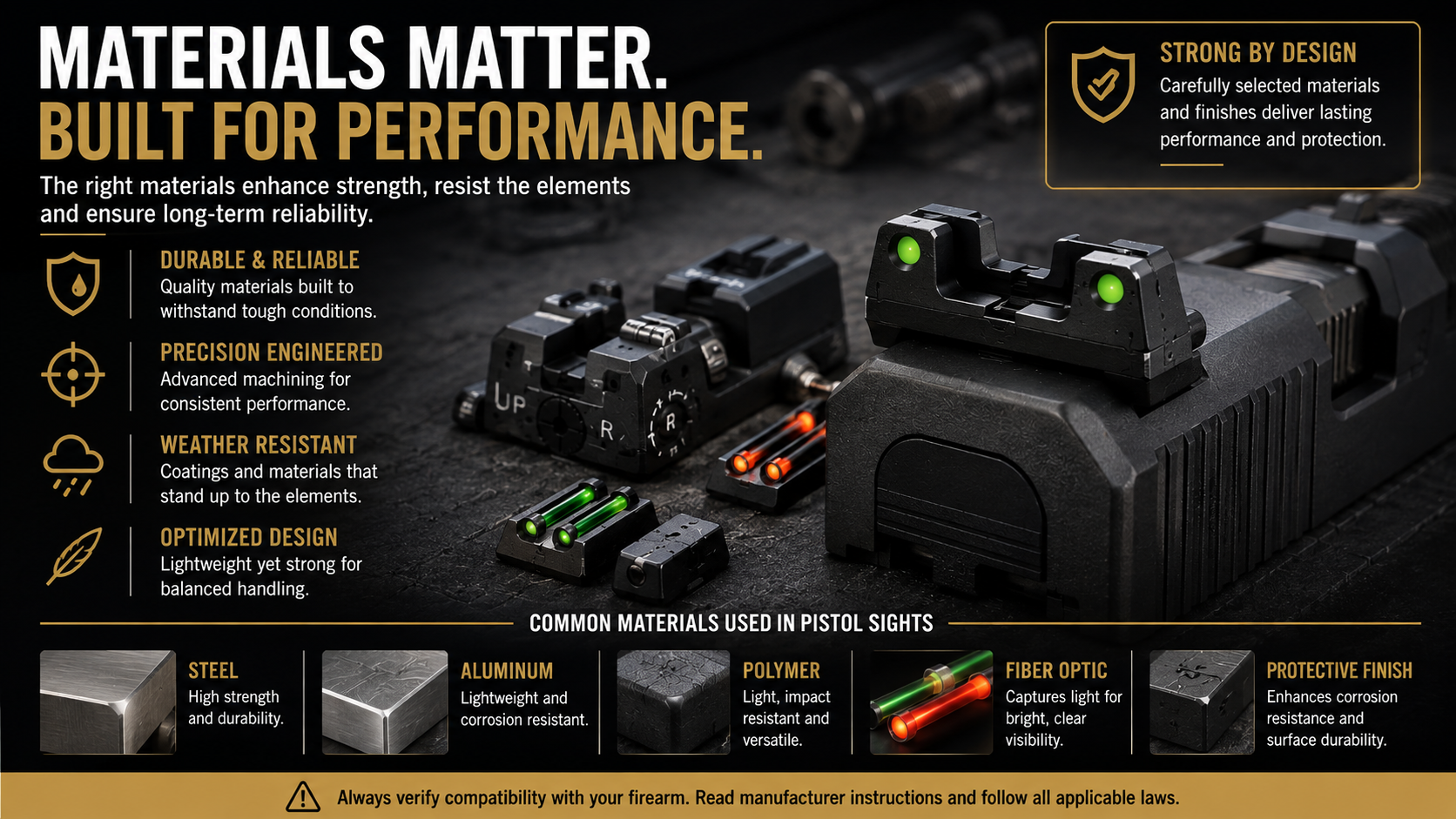
But weight isn’t a reliable indicator of quality.
A lighter sight is not inherently better, nor is a heavy sight inherently more robust.
In addition to structure, size, compatibility, intended use, and manufacturer standards, customers should consider weight.
Engineering and Product Quality
The process of turning materials into a final product is heavily influenced by engineering.
When creating a product, a manufacturer must take into account the product’s dimensions, construction, mounting configuration, materials, finish, and intended use.
In its product philosophy, Delta 1 emphasizes engineering and skilled machining.
This serves as an illustration of why consumers should think at the manufacturing process as a whole rather than just material names.
When assessing a product’s quality, engineering and production data can offer crucial context.
How Buyers Can Evaluate Material Claims
Product pages on the internet frequently utilize phrases like “premium,” “durable,” “precision engineered,” or “high quality.”
Technical specifications are not replaced by these terminology, even if they can be helpful marketing descriptions.
Purchasers should seek for information that is genuinely assessable.
These consist of the specified material, dimensions, finish, suitable firearm platforms, product design, warranty details, and manufacturer paperwork.
Customers will find it easier to make an informed choice if the product information is clear and detailed.
Why Compatibility Is Still Essential
If it is incompatible with the intended firearm, even a very well-made sight may be inappropriate.
The size and mounting arrangements of various pistol platforms can vary.
Because of this, compatibility should always be verified before making a purchase.
Consumers should determine the precise manufacturer and model of the handgun and compare it with the compatibility details for the particular sight.
It is not appropriate to use product photos as evidence of compatibility.
It is preferable to get in touch with the manufacturer or retailer before making a purchase if the information is unclear.
What to Check Before Buying
Before purchasing a pistol sight, customers can review several important factors:
- Verify the precise model and manufacturer of the handgun.
- Verify the compatibility details for the particular sight.
- Examine the listed building supplies.
- Check the mounting specs and measurements.
- Find out if the product is fully adjustable or fixed.
- Examine the care instructions and surface finish.
- Examine the warranty details and manufacturer’s documentation.
- If technical fitting is necessary, think about hiring a professional.
- Check the laws and rules that are in effect at the time of the purchase.
These steps can help customers compare products more effectively.
Maintenance and Long-Term Care
A well-designed sight nonetheless needs proper maintenance.
Consumers should adhere to the manufacturer’s maintenance, cleaning, inspection, and storage guidelines.
Care requirements can vary depending on the type of material.
While optical or electrical components may need extra thought, metal items may need to pay attention to moisture and rust.
Customers should adhere to manufacturer instructions and, if necessary, consider professional inspection if a sight becomes broken, cracked, rusted, loose, or otherwise dubious.
Unsupported repairs and modifications should be avoided.
Delta 1’s Approach to Sight Design
Delta 1 has created a unique method for designing contemporary handgun sights.
The firm emphasizes an open sight image, a simplified sighting idea, streamlined construction, and anti-snag features while providing fixed and completely customizable alternatives.
A component of its product positioning is its emphasis on engineering and machining.
The precise product specs continue to be the most crucial source of information for consumers, even though these aspects offer helpful areas to investigate.
Before making a purchase, customers should examine each Delta 1 product to learn about its design, compatibility, and intended use.
Quality Versus Price
When evaluating products, price is obviously significant, but it shouldn’t be the sole indicator of quality.
Just as a less expensive product is not always inappropriate, an expensive sight is not necessarily better.
Materials, manufacturing details, compatibility, design, warranty support, and intended use should all be compared by customers.
This method offers a more impartial foundation for product evaluation.
Responsible Product Selection
Choosing an accessory based on actual needs rather than just buying the item with the greatest features is known as responsible shopping.
Consumers should verify that the product’s specs match those of the intended firearm and comprehend the product’s purpose.
When it comes to technical fitting or installation, they should also go over the manufacturer’s instructions and get expert help.
Responsible Ownership
Pistol sights are just one aspect of owning a pistol.
Safe handling, maintenance awareness, adequate education, safe storage, responsible transportation, and adherence to relevant legislation continue to be crucial.
Responsible ownership behaviours cannot be replaced by any accessory.
New proprietors should learn about the regulations that apply to their area and think about getting the proper professional training.
Legal Considerations
Firearm-related rules might differ widely between jurisdictions.
Rules may apply to firearms, accessories, purchasing, possession, transportation, storage, and other actions.
These needs can also alter over time.
Customers should verify current rules through proper official sources before acquiring or possessing firearm-related products.
A product’s availability online does not guarantee that it is lawful for every consumer or jurisdiction.
A knowledgeable legal professional or the appropriate authority should be consulted by anyone unsure about applicable requirements.
Final Thoughts
Pistol sight materials affect performance and durability in a number of ways, but they are only one part of the whole product. In terms of construction, upkeep, weight, and environmental resistance, steel, aluminium, plastics, optical materials, and other materials can offer a variety of qualities.
Manufacturing quality is equally important. Engineering, machining, finishing, dimensional consistency, compatibility, and quality control all contribute to the finished product.
Delta 1’s strategy combines fixed and completely adjustable sight designs with an emphasis on an open sight image, a simplified sighting philosophy, streamlined construction, and anti-snag features. These features give buyers something to consider while researching modern handgun sights.
Customers should always confirm the precise firearm compatibility, go over the material and construction specifications, go over manufacturer documentation, comprehend warranty and maintenance requirements, and check any applicable legal requirements before making a purchase.
Above all, purchasers should refrain from evaluating a sight solely on the basis of one feature. Examining the entire product and assessing whether its listed specifications match the customer’s actual needs is the first step in making an informed purchase decision.
When investigating pistol sights and related firearm accessories, consumers can make better judgements if they are aware of the interplay between materials, engineering, manufacture, and maintenance.
Frequently Asked Questions
What is the significance of pistol sight materials?
Features including weight, construction, corrosion resistance, machining, and maintenance needs can all be influenced by the materials used. However, engineering and manufacturing can have an impact on overall quality.
Which materials are frequently found in handgun sights?
Steel, aluminium, plastics, optical materials, or mixtures of other materials may be used by manufacturers, depending on the design.
Is steel inherently superior to aluminium?
No, aluminium and steel have distinct properties. The manufacturer’s design, intended use, and product requirements all influence the choice of material.
Does a heavier sight imply more durability?
Not always. Durability cannot be determined solely by weight. Construction, material, production, finish, exposure to the environment, and upkeep are all important.
Does a sight’s endurance depend on its finish?
Protection and resilience to environmental elements like corrosion can be influenced by a surface treatment. But appropriate attention is still required.
Does machining impact the quality of the sight?
Dimensional uniformity and overall construction can be impacted by manufacturing and machining procedures. Along with other criteria, buyers should take machining information into account.
How can I determine whether a sight will work with my handgun?
Determine the precise model of firearm and compare it with the manufacturer’s compatibility data for the particular sight. Before making a purchase, get clarification if you’re unsure.
Are the materials used to make fixed and adjustable sights different?
They might be. The choice of material is determined by the manufacturer and specific product. The individual model’s specifications should be reviewed by customers.
Do pistol sights need to be installed by professionals?
A qualified specialist should be consulted if installation or fitting requires technical weapon knowledge. You should always adhere to the manufacturer’s directions.
Are pistol sights subject to regulations?
Location-specific regulations differ. Before acquiring or owning accessories related to firearms, consumers should confirm current regulations and regulations.
