


Understanding the differences between fixed and fully adjustable handgun sights and what each method is meant to provide is the first step in making a decision. Although both are intended to serve as a sighting reference, there may be significant differences in their overall design philosophy, construction, configuration, and adjustment features.
Choosing the device with the most features shouldn’t be the only consideration for consumers looking at contemporary pistol sights. Understanding each design’s features, confirming that it is compatible with the selected firearm platform, reviewing manufacturer specs, and determining which features are actually pertinent to the intended application are better methods.
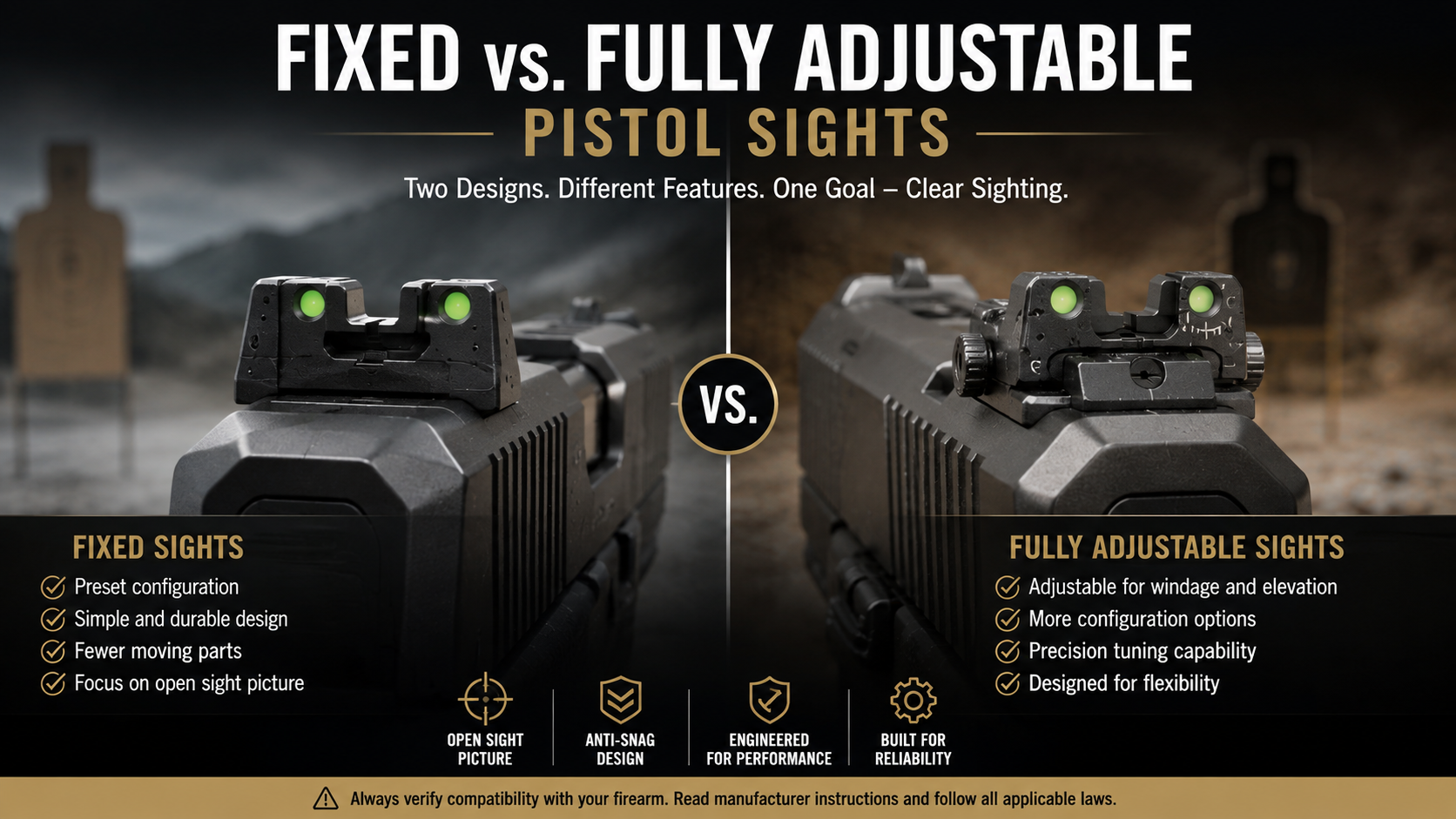
When investigating Delta 1 Sights, which come in both fixed and completely adjustable configurations, this is especially helpful. The brand places a strong emphasis on streamlined construction, an anti-snag design, a unique open sight picture, and a single-point sighting approach. Its product line is designed for various firearm platforms and applications, thus it’s crucial to assess each product separately rather than assuming all models have the same specs.
The main distinctions between completely adjustable and fixed pistol sights will be discussed in this guide, along with the design elements that consumers should be aware of and the factors to take into account when looking into a contemporary sight system.
Understanding Fixed and Fully Adjustable Pistol Sights
The configuration of fully adjustable and fixed handgun sights is the primary distinction between them.
The configuration of a fixed pistol sight is predetermined. The adjustment mechanisms included in an adjustable model are absent from its design. This results in a design that is comparatively simple and has fewer moving or adjustable parts.
On the other hand, a fully adjustable handgun sight has mechanisms that let you change some parts of its design. This offers an alternative degree of adaptability and may increase the product’s mechanical complexity.
In every circumstance, neither category should be deemed superior. The firearm platform, product specs, intended legal use, and the owner’s situation all influence the best option.
Understanding what they are truly purchasing is more crucial for consumers than presuming that a particular category is always better.
What Is a Fixed Pistol Sight?
The foundation of a fixed pistol sight is a preset arrangement.
The fundamental idea is simple: a fully adjustable model’s adjustment mechanisms are absent from the eye. However, various materials, profiles, finishes, and sight-picture concepts can be incorporated into modern fixed sights.
Thus, “fixed” does not always imply rudimentary or out-of-date.
A contemporary fixed sight can feature a well-thought-out design meant to offer a unique visual arrangement while preserving a reduced physical profile.
Based on its unique sighting philosophy, Delta 1 provides fixed sight devices. For instance, the Glock Fixed Sights product description emphasises single-point alignment and an open sight image as important features of the design.
Compatibility is still one of the most crucial considerations for clients thinking about purchasing a fixed sight. Before making a purchase, it is usually advisable to confirm the precise firearm model and manufacturer specs.
What Is a Fully Adjustable Pistol Sight?
Through adjustment mechanisms, fully adjustable pistol sights offer more configuration options.
These items often have a more sophisticated structure than fixed sights because they include parts that enable modifications to certain sight characteristics.
Customers who are explicitly searching for an adjustable design may find adjustable sights more intriguing as a result.
Nevertheless, a product is not always more suitable just because it has adjusting mechanisms.
The precise product specs, compatible firearm types, dimensions, construction, manufacturer instructions, and warranty details need still be reviewed by customers.
Instead of undertaking unfamiliar alterations, professional assistance should be obtained if installation or fitting requires technical firearm work.
Fixed vs. Adjustable: The Main Differences
Comparing the two categories’ basic traits is the simplest method to comprehend them.
A fully adjustable sight highlights configuration flexibility through adjustment mechanisms, whereas a fixed sight emphasises a set configuration and simple construction.
This distinction influences what consumers should look for when examining product pages from an e-commerce standpoint.
Customers may pay close attention to compatibility, dimensions, construction, sight design, and intended use when purchasing a fixed sight.
These factors are still crucial when using an adjustable sight, but consumers should additionally read the manufacturer’s instructions about the adjustment mechanism and product-specific specifications.
Rather than a straightforward “basic versus advanced” hierarchy, what matters is that the two groups represent distinct design approaches.
Understanding the Open Sight Picture
The Delta 1’s emphasis on an open sight picture is one of its most notable features.
In order to streamline the visual link between the shooter and the sighting system, the business bases its design on a single-point sighting idea.
Customers looking into handgun sights may find it helpful to comprehend this design philosophy because different sights employ different visual arrangements.
An open sight image is not a guaranty of the same outcomes for every individual or application, but rather a feature of the design. Sight perception can be influenced by a variety of factors, including personal circumstances, firearm configuration, and environmental conditions.
For this reason, rather of depending only on general performance claims, product research should concentrate on the precise design parameters.
The Single-Point Design Concept
A single-point sight image is likewise emphasised in Delta 1’s design concept.
This is one of the features that consumers could wish to comprehend when comparing contemporary sight designs, and it sets the product concept apart from more traditional sight arrangements.
Customers should take into account the manufacturer’s description of the sight, the firearm platforms that are supported, and if the specific model meets their needs when assessing this kind of design.
Because different models may have different design concepts, the product’s technical specs are still crucial.
Why an Anti-Snag Profile Matters
Delta 1 also highlights its anti-snag design.
Customers assessing how an attachment fits into a larger firearm configuration may find that a streamlined sight profile is a crucial design factor. Delta 1 characterises its sights as having a straightforward platform and an anti-snag design.
Customers should consider the entire product while evaluating this feature, though.
Before making a purchase, it is important to consider the physical profile, size, compatibility, materials, and intended use.
Instead of being the only factor in choosing a sight, an anti-snag description should be considered as one feature of the product.
Fixed Sights and Simplicity
Customers might be drawn to fixed sights because of their simple setup.
From an equipment-management standpoint, the design of fixed sights can be rather straightforward because they do not depend on the adjustment mechanisms included in adjustable types.
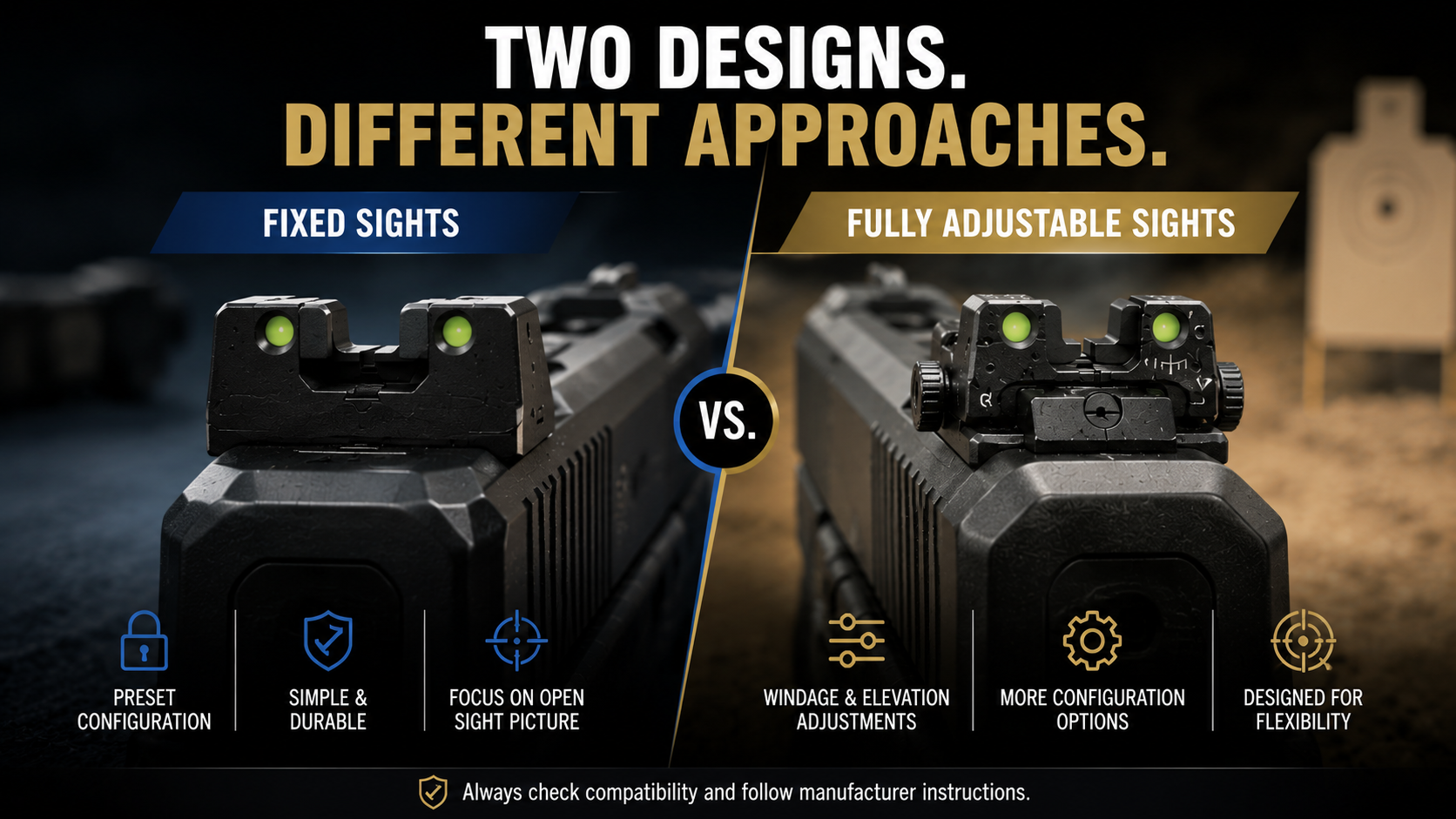
Customers who desire a certain sight setup may find such simplicity appealing.
Simplicity does not, however, make compatibility research unnecessary.
Customers should check the manufacturer’s specs before making a purchase because a fixed sight still needs to be made for the appropriate firearm platform.
Adjustable Sights and Flexibility
A new strategy is used with fully adjustable sights.
Although its adjustable mechanisms give the sight design greater flexibility, they also require consumers to thoroughly comprehend the product before making a purchase.
The precise features of the adjustment system, compatibility specifications, dimensions, and maintenance considerations can all be explained in manufacturer literature.
When installation or fitting is necessary, customers who are not experienced with technical firearm work should think about hiring a skilled professional.
Therefore, the primary distinction is not just that one product is “better.” Rather, distinct approaches to sight configuration are provided by fixed and adjustable sights.
Comparing Product Construction
When comparing pistol sights, construction is yet another crucial consideration.
Depending on the product, manufacturers may employ various metals, polymers, coatings, optical components, and other materials.
Instead of presuming that a specific material is inherently of superior quality, a consumer should examine the manufacturer’s claimed construction.
A more comprehensive assessment of quality should take into account construction, manufacturing data, documentation, compatibility, warranty support, and intended use.
According to Delta 1, its goals are designed and built with a focus on performance-oriented production and design.
Customers should still check each product’s specifications because different models may have different features.
Compatibility Should Come First
One of the most crucial elements in any pistol-sight purchase is compatibility.
The size, mounting arrangements, and manufacturer-specific specifications of various pistol platforms can vary.
Even if a sight looks identical to another product, it could not be compatible.
Customers should determine the precise firearm model and compare it with the compatibility information provided by the manufacturer before making a purchase.
Because photos cannot prove technical compatibility, this is particularly crucial when shopping online.
Before making a purchase, consumers should get in touch with the manufacturer, retailer, or a certified expert if the information is unclear.
Delta 1 Product Range and Platform Considerations
Products built around several firearm systems are available on the Delta 1 website. While the broader product range also includes additional pistol and sight applications, its product listings include configurations related to platforms like Glock.
A 45-degree Offset BattleSight product created in partnership with TROY is also listed by the firm. The Delta 1 sight-post design and offset sight application are mentioned in the product description.
This diversity upholds a crucial buying principle: buyers should consider the particular model rather than just the brand or overall product category.
Before making a purchase, it is important to establish the precise firearm platform, mounting arrangement, and product specs.
How Engineering Fits Into Sight Design
An essential component of contemporary sight development is engineering.
Physical dimensions, materials, manufacturing tolerances, compatibility requirements, and the intended product application must all be taken into consideration while designing a sight.
Instead of just replicating traditional sight configurations, Delta 1 places a strong emphasis on the engineering and manufacturing that go into their sight designs.
Engineering claims should be assessed by customers in conjunction with concrete product details.
Clear specs, suitable platforms, materials, warranty details, and manufacturer documentation should all be looked for.
Compared to marketing language alone, this gives a more comprehensive image of the product.
Quality Should Not Be Measured by Price Alone
When comparing pistol sights, price is undoubtedly a significant aspect, but it shouldn’t be the only one taken into account.
Not every buyer will find that a more expensive sight is the best choice.
Similarly, a less expensive product is not inherently inappropriate.
Instead, shoppers should consider the complete product:
- Materials and construction
- Compatibility
- Features of design
- Documentation from the manufacturer
- Support for warranties
- The intended use
- Requirements for maintenance
- Regulations that apply
This approach allows customers to compare products based on meaningful information rather than price alone.
What to Consider Before Choosing a Fixed Sight
Consumers who are thinking about purchasing a fixed sight should first verify the precise firearm platform and compatibility specifications.
The construction, measurements, design features, warranty details, and manufacturer documentation of the sight can then be examined.
Customers that prefer a predetermined configuration without adjusting mechanisms could find a fixed design appealing.
Customers should choose items based on stated requirements rather than conjecture, though, as individual circumstances are important.
To find out if the Delta 1 fixed-sight design’s features match the chosen rifle platform, one can examine the product listing.
What to Consider Before Choosing a Fully Adjustable Sight
Consumers who are thinking about purchasing a fully adjustable sight should go over the extra details related to the adjustment mechanism.
This covers measurements, installation specifications, compatibility details, manufacturer documentation, and maintenance considerations.
When an adjustment system is present, the consumer should be aware of the manufacturer’s requirements and the product’s design.
Professional help may be required if technical installation or fitting is required.
Once more, the objective is to choose a product that suitably satisfies the customer’s reasonable needs rather than the one with the most features.
Fixed or Adjustable: A Practical Comparison
Examining the two groups’ design principles is a helpful method of comparison.
In general, fixed sights prioritise a clear layout and simple design.
Fully adjustable sights incorporate extra mechanisms that make it possible to modify some aspects of the sight setup.
The visual arrangement that the sight system presents is the main focus of open sight-picture designs.
A streamlined physical profile is emphasised in anti-snag designs.
Customers should look at the specific model rather than depending just on category labels because these features may overlap within a single product.
Maintenance and Long-Term Care
Keeping an eye on the product’s condition is part of responsible equipment management.
When it comes to inspection, cleaning, maintenance, and storage, customers should adhere to the manufacturer’s instructions.
A professional inspection might be necessary if a sight becomes obviously damaged, loose, cracked, rusted, or otherwise dubious.
Unsupported repairs or alterations should be avoided by owners.
Maintaining the original warranty information, purchase records, and product documentation can help facilitate future support and maintenance.
Professional Assistance
Technical installation or fitting may be necessary for some handgun accessories.
Consumers who are not familiar with this kind of job ought to think about speaking with an expert.
This is especially crucial when an attachment calls for technical fitting or mounting specifications unique to a particular model.
You should always adhere to the manufacturer’s directions.
Just because an accessory seems simple doesn’t mean that it can be fitted safely.
Responsible E-Commerce Shopping
Online buying is convenient, however products related to firearms need to be carefully investigated.
Before making a purchase, customers should review the entire product listing and confirm the details.
Product photos can depict a product’s overall appearance, but they shouldn’t be used to verify compatibility.
For crucial technical information, manufacturer documentation should be examined.
Before placing an order, customers should also be aware of the retailer’s return policy and warranty details.
Before making a purchase, get in touch with the manufacturer or store if a product’s specifications are unclear to prevent placing an incorrect order.
Legal Considerations
Laws pertaining to firearms differ greatly between states.
Ownership, purchasing, storage, transportation, accessories, and other activities involving firearms may all be subject to requirements.
Over time, regulations may also alter.
Therefore, before buying or possessing firearm-related products, consumers should confirm current regulations through the relevant official authorities.
A product’s online availability does not guaranty that every consumer is able to buy or own it.
Customers should speak with the relevant government or a certified legal professional where legal requirements are unclear.
A Responsible Sight Comparison Checklist
Before choosing between a fixed and fully adjustable pistol sight, customers can consider:
- Verify the precise model of the handgun and the compatibility of the sight.
- Determine whether the genuine requirement is met by a fixed or changeable arrangement.
- Examine the specific product’s measurements and design.
- Examine the warranty details and manufacturer’s documentation.
- Recognise the design elements of the object, such as the sight profile and sight-picture concept.
- Examine the requirements for upkeep and care.
- If technical installation or fitting is required, think about hiring an expert.
- Before making a purchase, confirm any applicable laws and restrictions.
This checklist is intended to support informed shopping and does not replace professional or legal advice.
Final Thoughts
In the end, comparing fully adjustable versus fixed handgun sights comes down to comprehending two distinct design philosophies.
While fully adjustable sights include mechanisms that offer more configuration flexibility, fixed sights have a specified configuration and comparatively simple construction. The best option depends on the particular product, firearm platform, lawful use, and client conditions; neither strategy is always better.
With its focus on an open sight picture, single-point sighting concept, streamlined construction, anti-snag features, and availability in both fixed and completely adjustable configurations, Delta 1 offers a unique design philosophy to this category.
The most crucial step for consumers looking into these products is to look past marketing jargon and look at the precise features of the product under consideration. Before making a purchase, one should examine compatibility, construction, size, manufacturer documentation, warranty information, and any applicable legal requirements.
Knowing what a product is intended to perform and whether it is suitable for the particular situation are ultimately key components of informed shopping. Customers can make better judgements while maintaining responsible ownership and safety at the core of the process by carefully comparing fixed and fully adjustable designs and investigating each product.
Frequently Asked Questions
What distinguishes fully adjustable pistol sights from fixed ones?
A completely adjustable sight includes devices that enable specific aspects of its setup to be altered, whereas a fixed sight has a predetermined configuration. The firearm platform, product specs, and intended use all influence the best choice.
Are completely adjustable sights always superior to fixed ones?
No, having more adjustment options does not inherently make a sight more suitable. Consumers should think about design, documentation, compatibility, and their own valid needs.
What distinguishes Delta 1 Sights?
Delta 1 places a strong emphasis on streamlined construction, an anti-snag design, an open sight picture, and a single-point sighting concept. Both completely adjustable and fixed setups are available from the manufacturer.
An open sight picture: what is it?
A sight design meant to offer a comparatively unhindered visual reference is called an open sight picture. The manufacturer’s design determines the precise features.
What is meant by “anti-snag design”?
A streamlined physical profile meant to reduce protruding features is commonly referred to as an anti-snag design. In its product description, Delta 1 expressly emphasises this feature.
How can I determine which Delta 1 product is compatible with my gun?
Verify the precise firearm model and contrast it with the Delta 1 product’s compatibility details. Get in touch with the manufacturer or a trained expert if the information is unclear.
Does a pistol sight’s material matter?
One consideration when assessing a sight is the building materials. Dimensions, compatibility, manufacturer documentation, warranty support, intended use, and maintenance needs should all be taken into account by customers.
Do pistol sights need to be installed by professionals?
A qualified professional should be consulted if installation or fitting requires technical firearm knowledge. You should always adhere to the manufacturer’s directions.
Are pistol sights permitted everywhere?
Jurisdiction-specific regulations are subject to change. Customers should verify current requirements through appropriate official sources before purchasing or possessing firearm-related accessories.
