


The design is just one factor to consider while selecting a contemporary handgun sight. The sight’s strength, weight, environmental resistance, look, and long-term maintenance needs can all be influenced by the materials used in its construction. Customers looking for fixed and fully adjustable pistol sights may find it easier to evaluate items based on meaningful specifications rather than merely appearance or price if they are aware of the material options.
Despite its seemingly modest size, a pistol sight is made to withstand harsh conditions as part of a handgun system. Because of this, while evaluating various items, building quality is crucial. A sight’s ability to work and endure its intended environment can be influenced by a variety of factors, including materials, manufacturing techniques, protective coatings, optical components, and general engineering.
With a focus on an open sight image, streamlined construction, and anti-snag features, Delta 1 Sights takes a unique approach to sight design, providing both fixed and completely adjustable alternatives. As part of its product philosophy, the company also emphasises its engineering and machining processes.
However, it’s crucial for consumers looking at pistol sights to go behind generic marketing claims. For each sight under evaluation, the precise material specifications, compatibility data, product literature, intended use, and maintenance instructions should be taken into account.
In addition to offering useful information for clients evaluating contemporary sight designs, this book illustrates the connection between pistol sight materials and durability.
Why Materials Matter in Pistol Sight Design
Numerous aspects of a manufactured object are influenced by its materials.
The choice of material can have an impact on the structural characteristics, weight, corrosion resistance, surface polish, manufacturing accuracy, and long-term maintenance needs of pistol sights. Additionally, different materials may be suitable for various design specifications.
But no single material should be the ideal choice in every circumstance.
The raw material is not the only factor that determines a sight’s quality. Additionally crucial are manufacturing procedures, engineering tolerances, finishing, design, quality assurance, and intended use.
Customers should therefore take into account the entire product rather than concentrating on a single feature.
A well-thought-out sight constructed of the right material can provide a variety of features appropriate to its intended use.
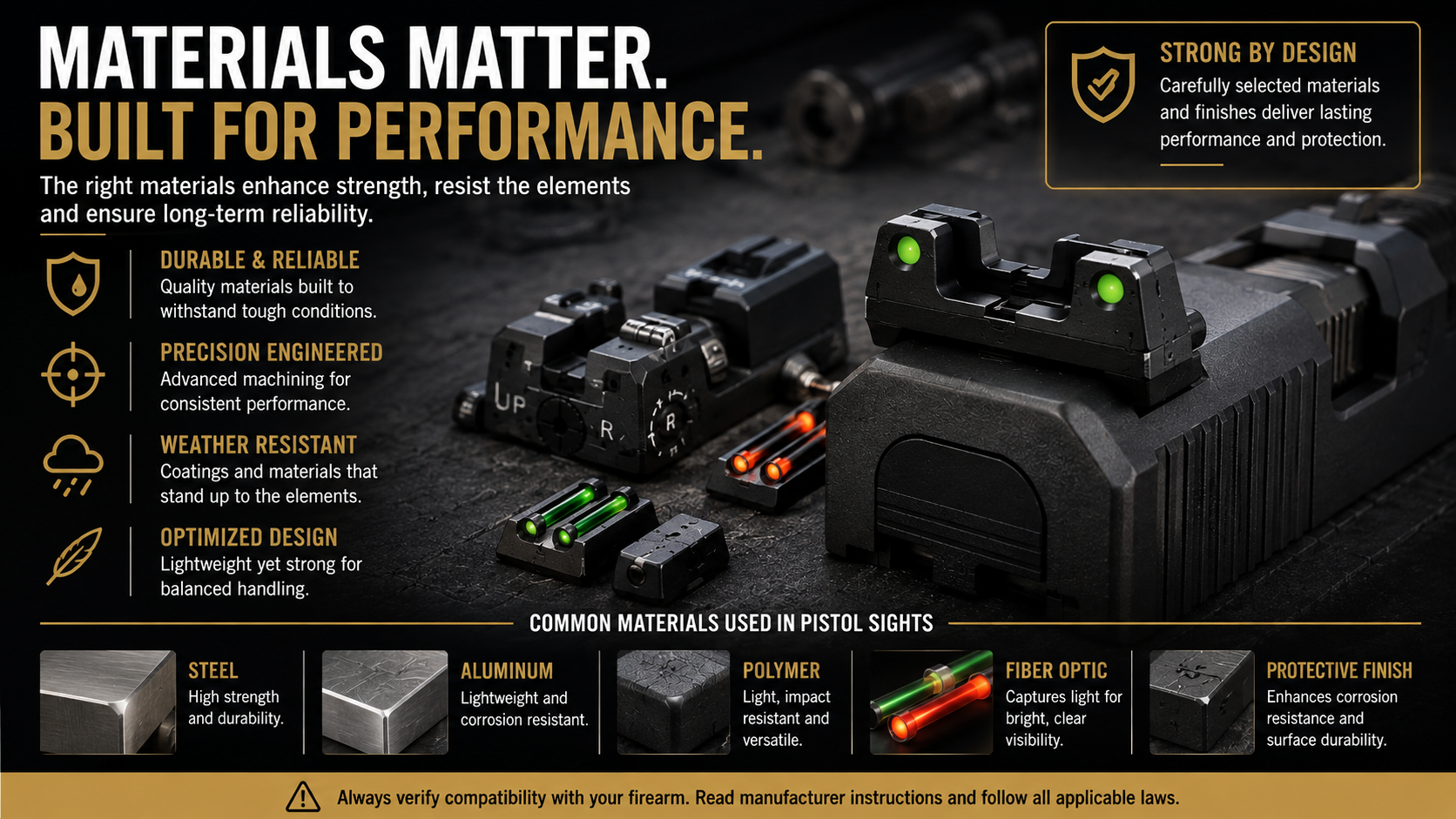
Common Materials Used in Pistol Sights
A variety of materials can be used in the production of contemporary handgun sights.
Because it can offer a sturdy base for a small component, metal is frequently linked to both conventional and contemporary sight building. The strength, weight, corrosion resistance, and machinability of various metal kinds can be combined in different ways.
Certain sight designs may also use materials based on polymers. These materials might offer various production qualities and weights.
When a sight uses fiber-optic technology or other visual components, certain materials may be used for optical components.
Additional materials and parts related to batteries, circuits, protective housings, and illumination systems may be introduced by electronic sight systems.
Customers should always refer to the specifications provided by the particular manufacturer because items differ.
Metal Construction and Durability
A common element of many pistol sight designs is metal fabrication.
Hardness, weight, corrosion resistance, and machinability are just a few of the characteristics that can vary amongst metals. Therefore, a manufacturer’s approach to the overall design may be influenced by the metal selection.
But just knowing that a sight is composed of metal is insufficient to assess its quality.
In addition to finishing, construction, size, warranty coverage, and intended use, customers should seek for the manufacturer’s unique material information.
Quality of manufacturing is also important. A well-engineered product may benefit from precise machining and suitable quality-control procedures.
Steel and Its Characteristics
Steel’s strength, durability, and machinability make it a common material for industrial goods.
Customers should not treat all steel items as the same because different types of steel have varied qualities.
The intended use, design specifications, manufacturing method, and desired qualities can all influence a manufacturer’s choice of steel.
Corrosion resistance and appearance can also be influenced by surface treatment.
Customers should check the manufacturer’s information to determine what is truly being offered when a product listing mentions a specific steel type or finish.
Aluminum and Lightweight Construction
Compared to steel, aluminium can offer a different set of qualities.
It is widely acknowledged for its practical machinability and comparatively low density, which make it appropriate for a variety of engineered goods.
Aluminium can help create a lightweight design when utilised in sight building.
Nonetheless, context should always be taken into consideration while choosing materials. The manufacturer’s design goals, product specifications, and intended use all influence the choice of material.
Consumers shouldn’t believe that a heavier product is always more durable or that a lighter product is inherently better.
Weight alone is not as important as the entire construction.
Polymer Materials
Certain sight designs and associated firearm accessories can also be made of polymer-based materials.
Low weight, flexibility in production, and resilience to specific environmental conditions are some benefits that polymers can provide.
However, the characteristics of various polymers vary greatly.
Therefore, instead of drawing conclusions from the phrase “polymer,” consumers should examine the manufacturer’s specifications.
It is also important to take into account a product’s intended use, construction, warranty details, and environmental restrictions.
Optical Materials and Fiber-Optic Elements
Optical materials are included into several handgun sight designs, especially those that use fiber-optic technology.
The purpose of fiber-optic elements is to use an optical substance to transfer available light. Compared to traditional metal sight components, they have different qualities.
Customers should examine the manufacturer’s standards on construction, intended use, environmental restrictions, and maintenance when assessing products that involve optical elements.
The entire sight consists of more than only the optical component. Additionally important are the mounting configuration, adjacent housing, and general design.
Finishes and Surface Protection
Choosing the right materials is just one aspect of durability.
The look, corrosion resistance, and protection of the underlying material can all be impacted by the surface finish used on a sight.
Depending on the product, manufacturers may employ several finishes.
Clear information regarding the finish and its intended features should be sought for by customers.
A product’s resistance to corrosion or environmental harm should not be taken for granted just because it has a protective surface. Storage and proper maintenance are still crucial.
Corrosion Resistance
Over time, metal goods may be impacted by environmental exposure.
Under some circumstances, corrosion can be caused by moisture, humidity, salts, chemicals, and other environmental elements.
Corrosion resistance can be influenced by the material, surface polish, storage conditions, and maintenance procedures.
As a result, consumers should review the care and storage guidelines provided by the manufacturer.
Owners should adhere to the relevant manufacturing instructions and, if need, think about hiring an expert inspector if a sight exhibits obvious corrosion or damage.
Environmental Exposure
Depending on how and where they are carried or stored, pistol sights may come into contact with various environmental conditions.
Over time, equipment may be impacted by variations in temperature, humidity, moisture, dust, and other environmental conditions.
For their products, manufacturers may offer care guidelines or environmental requirements.
Instead of presuming that every sight is made for the same conditions, customers should carefully examine these specifics.
The manufacturer’s guidelines should be followed while maintaining a device designed for a certain use.
Manufacturing Quality Matters
Product quality is not solely determined by raw materials.
Manufacturing procedures can be just as significant.
The finished product may benefit from precision machining, dimensional consistency, finishing, quality control, and inspection techniques.
As part of its sight-development strategy, Delta 1 places a strong emphasis on engineering and machining.
This emphasises a crucial idea for consumers: assess the product’s manufacturing facts as well as its material.
Customers have a better foundation for making an informed purchase decision when a product is well-specified.
How Material Choice Relates to Product Longevity
The choice of material can affect a product’s behaviour over time, although longevity is dependent on a number of variables.
The material itself, surface treatment, manufacturing quality, exposure to the environment, upkeep, storage, and the degree to which the product is used in accordance with its intended specifications are a few examples.
As a result, no material can ensure an endless service life.
When available, the manufacturer’s expected service details, warranty coverage, maintenance instructions, and product limits should be reviewed by customers.
Treating durability as a set of product attributes rather than a single material standard is a sensible approach.
Fixed Sights and Material Considerations
Although the construction of fixed sights is frequently somewhat simple, material choice is nevertheless crucial.
When comparing fixed models, buyers should review the manufacturer’s details regarding construction, dimensions, finish, compatibility, and intended usage.
Depending on the particular design, a fixed sight may use optical components, polymer components, metal construction, or a combination of materials.
Delta 1’s unique open sight-picture idea and streamlined form serve as the foundation for its fixed sight solutions.
Instead of assuming that every fixed sight employs the same materials or construction, customers should check the specs of each model.
Fully Adjustable Sights and Material Considerations
In contrast to fixed designs, fully adjustable sights may require additional mechanical components.
Customers should therefore focus on the construction of adjustment-related components in addition to the main sight material.
Information on materials, dimensions, adjustment mechanisms, maintenance, and compatibility can be found in manufacturer documentation.
Consumers should refrain from assuming anything about the installation or modification of an adjustable sight. Professional assistance from experienced individuals may be necessary when technical fitting is needed.
The Relationship Between Weight and Material
The choice of materials can affect a sight’s weight.
Because the densities of steel, aluminium, polymer, and other materials vary, manufacturers can attain varying weight characteristics based on their building choices.
But weight shouldn’t be considered in a vacuum.
A heavier product is not inherently more durable, and a lighter product is not inherently superior.
Along with structure, dimensions, compatibility, intended use, and manufacturer standards, customers should take weight into account.
Material Quality Versus Marketing Claims
Some terms used in online product descriptions include “premium,” “heavy-duty,” “precision engineered,” and “extremely durable.”
Customers should check for supporting specifications even if these terms may draw attention.
Broad advertising language may not always convey as much relevant information as material type, construction specifications, production information, warranty coverage, and specified product restrictions.
Combining manufacturer documentation with product-page information is the best strategy for an online buyer.
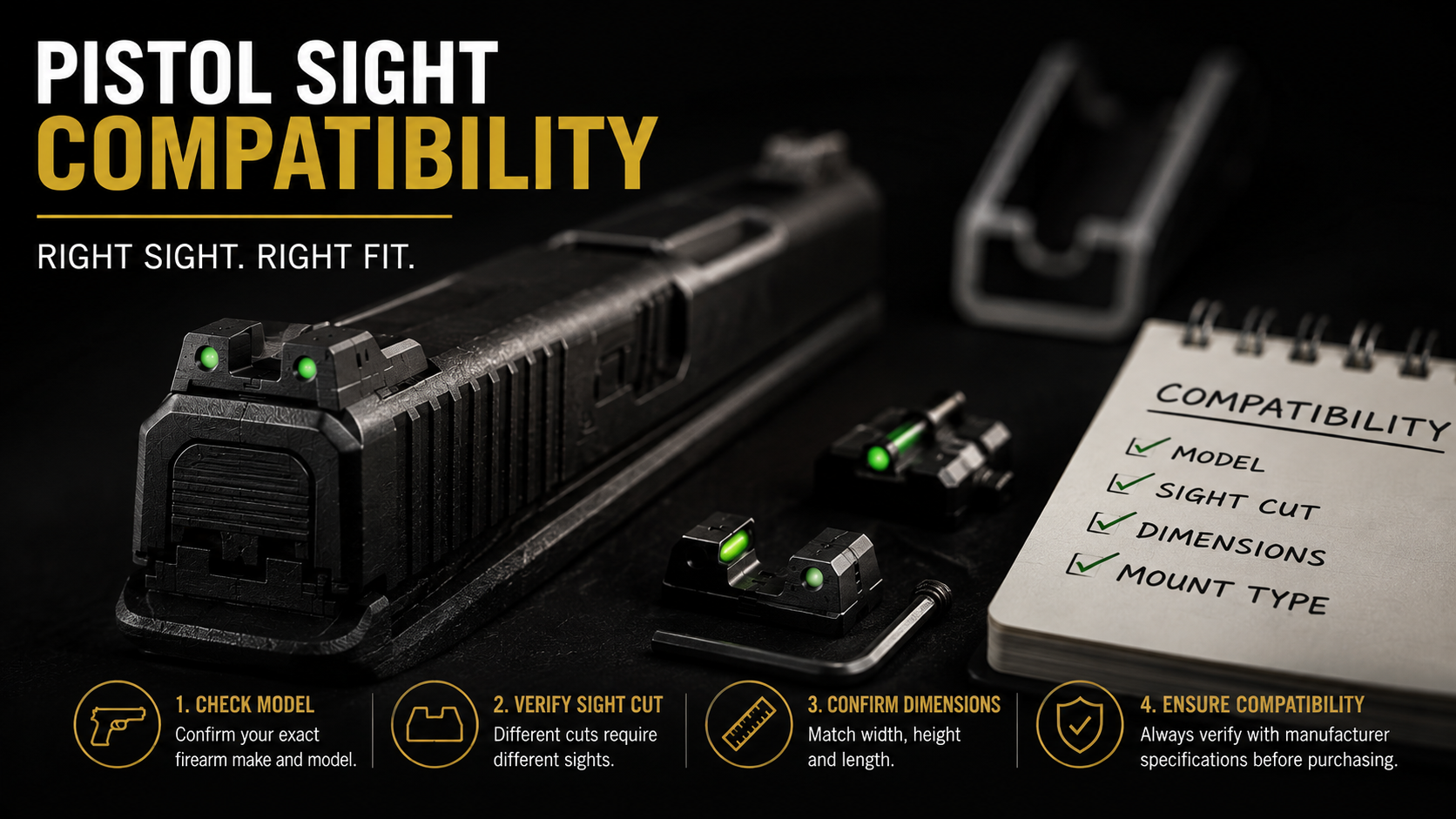
Why Compatibility Still Matters
An accessory is not always compatible with every rifle, even if it is made of a high-quality material.
Dimensions, mounting configurations, and other aspects of pistol sight designs might vary depending on the model.
Customers should determine the precise model of firearm and check it against the compatibility data provided by the manufacturer.
Because photos cannot prove technological compatibility, this is particularly crucial when making an online purchase.
Before making a purchase, consumers should get in touch with the manufacturer, retailer, or a trained expert if compatibility is questionable.
Maintenance and Material Care
Care considerations may vary depending on the type of material.
Products made of metal may need to be protected from corrosion and moisture. There may be particular cleaning needs for optical components. Batteries and the environment may be factors in electronic items.
Instead than implementing a general maintenance schedule to every product, customers should adhere to the manufacturer’s guidelines.
A professional assessment could be necessary if an accessory is corroded, cracked, broken, or otherwise doubtful.
It is best to avoid unsupported fixes and alterations.
Storage and Environmental Protection
Long-term equipment condition can be significantly impacted by storage conditions.
Regarding storage, moisture, temperature, and exposure to the environment, customers should adhere to the manufacturer’s guidelines.
Accessories can be shielded from needless deterioration by being stored properly.
Additionally, owners of firearms should keep their weapons stored securely to prevent unwanted access, especially in homes where children or other unauthorised people might be present.
Firearm storage and accessory care should be seen as distinct but connected duties.
Evaluating a Sight Before Purchase
Consumers can use a methodical approach while researching handgun sights.
Start by figuring out which sight categories are compatible with the specific rifle model.
Next, go over the manufacturer’s specifications for construction and materials.
Next, take into account the dimensions, finish, design features, warranty details, and upkeep needs.
Lastly, go over any laws that may be relevant and any limitations on the product’s possession or purchase.
This procedure can decrease the possibility of making an inappropriate purchase and make online purchasing more deliberate.
A Practical Material and Durability Checklist
When evaluating the materials and construction of a pistol sight, shoppers can consider the following:
- Verify the precise material or materials that the manufacturer has specified.
- Examine any details regarding protective treatment or surface finish.
- Verify the product’s measurements and suitability for firearms.
- Recognise whether optical or electronic components are used in the design.
- Examine the maintenance and environmental suggestions.
- Verify manufacturer support and warranty coverage.
- Think about if the customer’s situation aligns with the product’s intended use.
- When a technical fitting or inspection is necessary, consult an expert.
This checklist is intended to support informed product research and does not replace professional advice.
Delta 1’s Engineering Approach
Engineering, machining, and a unique sight design are key components of Delta 1’s product positioning.
An open sight image, a streamlined single-point sighting paradigm, and an anti-snag profile are highlighted in the company’s product specifications. Additionally, it provides fully adjustable and fixed configurations.
These features demonstrate how material selection fits into a larger design philosophy from the standpoint of product research.
The content is not the whole narrative. Equally important is how a manufacturer integrates material, geometry, manufacturing, finish, and product purpose.
Therefore, customers should check the characteristics of each Delta 1 product.
Choosing Based on the Intended Application
When studying a site, customers should always take the application into account.
A device designed for one firearm platform or ownership situation might not be suitable for another.
Compatibility, written specifications, construction, intended usage, and unique conditions all influence the best option.
For this reason, generalisations regarding “the best” sight or “the most durable” material should be viewed with caution.
Finding the real need and comparing products to it is a superior strategy.
Responsible E-Commerce Research
Careful investigation should be done before making an online purchase.
Consumers should study the product description in its entirety, examine the specs, consult the manufacturer’s documentation, and comprehend the return and warranty policies.
Before placing an order, get in touch with the manufacturer or store if a product’s specifications are unclear to avoid making an inappropriate purchase.
Although they can offer more information, customer reviews shouldn’t take the place of product specs.
Expert advice may be necessary for technical enquiries pertaining to firearm components.
Legal Considerations
Regulations pertaining to firearms differ by jurisdiction.
Ownership of firearms, attachments, purchases, transit, storage, and other actions may all be subject to requirements.
Over time, regulations may also alter.
Before acquiring or owning firearm-related products, consumers should confirm current regulations with the relevant official sources.
A product’s online availability does not guaranty that every consumer is able to buy or own it.
Customers should speak with the relevant government or a certified legal professional where legal requirements are unclear.
Final Thoughts
Important features including structure, weight, corrosion resistance, environmental endurance, and maintenance needs can be influenced by the materials used to make pistol sights. However, a product’s quality cannot be determined only by its substance.
The final product is influenced by the engineering, finishing, manufacturing process, dimensions, compatibility, warranty support, and intended use.
The method used by Delta 1 shows how material selection can be a component of a more comprehensive sight-design philosophy. The brand emphasizes an open sight image, streamlined design, anti-snag features, and engineering-focused manufacture while providing fixed and completely customizable setups.
Instead of making generalizations about a category or material, the most crucial step for consumers investigating these products is to look at the specific model.
Before making a purchase, consumers should confirm compatibility, go over manufacturer specifications, comprehend maintenance needs, take the environment into account, and look up any applicable regulatory requirements.
A responsible purchasing decision is based on reliable information rather than price or marketing language alone. By understanding how materials relate to construction and durability, customers can approach modern pistol-sight shopping with greater awareness and make decisions that are appropriate for their individual circumstances.
Frequently Asked Questions
Why are materials important while building a pistol sight?
Features including weight, structural qualities, corrosion resistance, manufacturing specifications, and long-term care can all be influenced by the materials used. However, the combination of engineering, manufacturing, and material selection determines the overall quality of the product.
Which materials are frequently found in handgun sights?
Manufacturers may utilise steel, aluminium, plastics, optical materials, or mixtures of various materials, depending on the product. Manufacturer specs should be used to verify the precise structure.
Is aluminium always inferior to steel?
No. The properties of various materials vary. The manufacturer’s design, intended use, building specifications, and product specifications all influence the best option.
Is it preferable if the sight is lighter?
Not always. One feature of a product is its weight. Construction, dimensions, compatibility, intended use, warranty, and manufacturer documentation should all be taken into account by customers.
Does durability depend on the surface finish?
Features like corrosion resistance and protection of the underlying material can be affected by a surface treatment. Consumers should check the manufacturer’s details regarding the particular finish.
How can I prevent corrosion on a sight?
Consumers should adhere to the care and storage guidelines provided by the manufacturer and refrain from subjecting goods to circumstances that exceed their stated restrictions. The proper expert or manufacturer advice should be taken into consideration if corrosion appears.
Are the materials used to make adjustable and fixed sights the same?
Not always. Different materials and building techniques can be used in different goods. Consumers who are considering a particular model should examine its specifications.
Is the quality of manufacture just as important as the material?
Indeed. Product quality is comprised of more than just material. The finished product may also be impacted by engineering, machining, finishing, dimensional uniformity, and quality control.
How can I find out if a sight is compatible with my gun?
Determine the precise model of firearm and compare it with the manufacturer’s compatibility data for the particular sight. Before making a purchase, get clarification if the information is confusing.
Does a sight need to be installed by a professional?
It is wise to speak with a qualified expert if installation or fitting calls for technical weapon knowledge. You should always adhere to the manufacturer’s directions.
